


Die casting injects molten metal under high pressure into a reusable steel die, where it cools and solidifies into shape. Depending on how the injection mechanism meets the metal, the process splits into two basic forms: hot chamber and cold chamber. The two differ in machine structure, in the alloys they can run, and in how production is organised.
The words “hot” and “cold” describe the temperature of the injection mechanism itself, not the die or the casting. In a hot chamber machine the injection mechanism sits submerged in the liquid metal of the melting furnace. In a cold chamber machine it stays clear of the liquid metal and only meets the alloy when a measured dose is poured in for the next shot. That structural difference sets the alloy range and the part range each process can serve.
What Is Hot Chamber Die Casting?
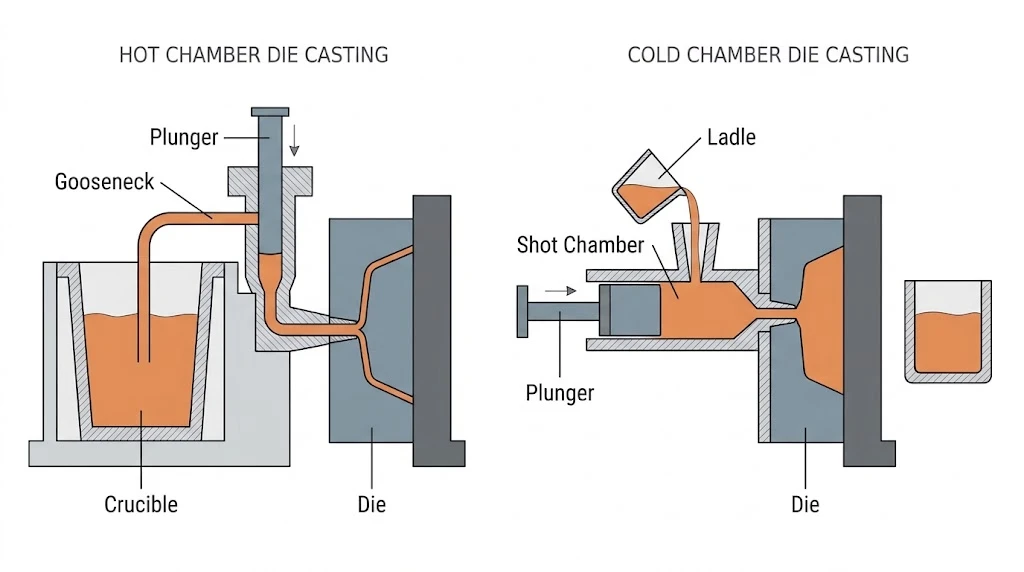
Hot chamber die casting integrates melting, holding and injection in one machine. Metal is melted and kept liquid in a crucible attached to the machine, usually enclosed and blanketed with protective gas to limit contact with air. The injection mechanism consists of a gooseneck, a plunger and a nozzle, all immersed in the melt. When the plunger travels down, it drives metal through the gooseneck and out of the nozzle into the die cavity. On the return stroke the gooseneck refills from the crucible and the cycle begins again. The nozzle is heated separately so the metal inside it does not freeze, and some machines keep the nozzle full of melt between shots to shorten the wait.
Hot chamber suits metals with low melting points that do not react noticeably with steel components. Zinc, tin and lead alloys are the common case, and some magnesium alloys can run this way given the right machine and cover gas. Aluminum is not one of them, and not only because of its melting point: at casting temperature it reacts with iron-based parts such as the gooseneck and plunger, and those parts wear out quickly. Zinc alloys with a high aluminum content are normally cast in cold chamber machines for the same reason.
How Hot Chamber Die Casting Works
Once the die is closed, the plunger moves up and uncovers the fill port in the side of the gooseneck, letting melt from the crucible flow in under the head of liquid above it. The plunger then drives down, pushing that metal up the gooseneck and through the nozzle into the die cavity. The nozzle meets the sprue of the die, and from that point the plunger pressure carries the metal through the cavity. At the end of filling the plunger holds its forward position and keeps pressure on the casting until it solidifies. The die opens, ejector pins push the part out, and the casting leaves with its sprue and biscuit attached, which are trimmed off and returned to the crucible. The cavity is cleaned and sprayed with release agent, the die closes, and the plunger moves up to refill the gooseneck for the next shot.
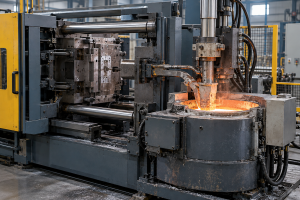
Because the nozzle stays hot and its contact with the die is brief, and because metal travels from crucible to cavity with almost no exposure to air along a short path, the cycle stays compact and thin walls with fine detail are easier to fill.
Advantages of Hot Chamber Die Casting
- No transfer of liquid metal — Metal melts and holds in the crucible built into the machine, so there is no ladle or dosing arm carrying a measured dose to the injection unit. The melt has less exposure to air and holds a steadier temperature.
- Short cycle — Without a ladling step, the cycle is essentially injection, solidification and part removal, which gives good output per hour on parts that suit the process.
- Well suited to thin walls and fine detail — A short fill path and a stable melt temperature make fine texture, small ribs and thin sections easier to produce.
- Moderate heat load on the injection mechanism — Zinc, tin and lead melt at comparatively low temperatures, so dies and injection parts see less thermal shock and die heat checking is less of an issue.
- Easy return of process scrap — Gates, biscuits and overflow can go straight back into the crucible for remelting without a separate recovery route.
Disadvantages of Hot Chamber Die Casting
- Narrow alloy range — Melting point and compatibility with steel components restrict the process to zinc, tin, lead and some magnesium alloys. Aluminum and copper alloys cannot run in a hot chamber machine.
- Limited part size — Plunger stroke and gooseneck volume cap the shot, so the injection capacity does not reach large projected areas or thick sections. Hot chamber parts are typically small to medium.
- Injection parts are consumables — The gooseneck, plunger and crucible sit in the melt and have to be replaced on a regular schedule, so maintenance and downtime are a standing cost of running the machine.
- Interaction between melt and iron-based parts — Continuous contact with steel components leads to wear on those parts and to changes in melt composition, which production has to manage through material choice and process control.
- Hard to meet high internal soundness — Parts needing tight pressure tightness or high internal quality usually call for structural die casting routes such as high vacuum, and those routes are built mainly on cold chamber machines.
What Is Cold Chamber Die Casting?
Cold chamber die casting separates melting from injection. Metal is melted and held in a separate furnace, and the machine itself has no melt pool. The injection unit is a horizontal shot chamber with a plunger inside it; the chamber only meets liquid metal at the moment of the shot and is “cold” the rest of the time. Metal is taken from the furnace, poured through the pouring hole into the shot chamber, and driven into the die cavity by the plunger.
The alloy range is wider than for hot chamber. Aluminum, copper and copper alloys, some magnesium alloys and high-aluminum zinc alloys are all cast this way. Horizontal machines dominate, with the shot chamber running horizontally and the die sprue fitted to its front end; vertical machines serve special geometries or jobs that need inserts loaded into the die.
How Cold Chamber Die Casting Works
The furnace melts the metal, refines it and holds it at the required pouring temperature, with degassing, slag removal or grain refinement applied as needed. For the shot, a ladle or dosing unit takes a measured quantity from the furnace and pours it through the pouring hole into the shot chamber, which at that point contains liquid metal and the air around it. The plunger starts forward at low speed, pushing the metal toward the front end and driving the air in the chamber and cavity out through the die vents. This part of the stroke is the slow shot. As the metal reaches the gate, the plunger switches to its fast stage and fills the cavity in a very short time. At the end of filling the plunger stays forward and keeps pressure on metal that is not yet fully solid, offsetting solidification shrinkage.
The casting cools in the die until it is stiff enough to handle, the die opens, and ejector pins push out the part together with its sprue and biscuit. The runner and biscuit are trimmed off and the casting moves to finishing, while the die is cleaned, sprayed and closed for the next cycle. Compared with hot chamber, every cold chamber shot includes a ladling and pouring step, and the shot chamber and plunger separate from the metal afterwards, so the cycle runs longer.
Advantages of Cold Chamber Die Casting
- Covers high-melting alloys — Aluminum, copper and copper alloys, some magnesium alloys and high-aluminum zinc alloys all run on cold chamber machines, and switching alloy means changing the die and the process settings rather than the process itself.
- Handles larger parts — Shot chamber capacity and clamping force can be built very large, so there is equipment available for sizable housings and structural parts.
- Higher injection capability — Cold chamber machines generally run at higher specific injection pressure than hot chamber machines, which with a sound runner and venting design gives more filling capability on thicker walls and large projected areas.
- More room for melt treatment — A separate furnace makes degassing, slag removal, grain refinement and filtration easier to carry out, and lets melt quality be controlled independently of the machine.
- Mature equipment and supply chain — Large-tonnage machines, vacuum systems and automated ladling and extraction are all well established, so there is a broad choice of equipment.
Disadvantages of Cold Chamber Die Casting
- Longer cycle — Every shot needs a ladling and pouring step, and the shot chamber has to separate from the metal afterwards, so hourly output is lower than on a hot chamber machine.
- More runner scrap — Sprue, runners, gates and overflow all solidify with the casting, which reduces material yield and sends the scrap back through remelting.
- Risk of entrained gas and porosity — Pouring, transfer and high-speed filling all carry the chance of gas entrapment, and conventional cold chamber castings contain porosity. Where heat treatment or welding is required, structural routes such as high vacuum, squeeze or semi-solid casting are usually needed.
- High thermal load on the die — Hot metal erodes the cavity and drives a more severe thermal cycle, so die material, cooling design and die life need close attention.
- Higher cost of managing hot metal — The melt must be held at high temperature, which raises energy use and the safety measures needed around melting, holding and transfer.
Key Differences Between Hot Chamber and Cold Chamber Die Casting
| Feature | Hot Chamber Die Casting | Cold Chamber Die Casting |
|---|---|---|
| Melting location | Crucible built into the machine | Separate melting furnace |
| Metal delivery | Gooseneck fills directly from the crucible | Measured dose poured into the shot chamber before each shot |
| Injection mechanism | Immersed in the melt, continuously hot | Clear of the melt, contacts it only during the shot |
| Suitable alloys | Zinc, tin, lead and some magnesium alloys | Aluminum, copper and copper alloys, some magnesium alloys, high-aluminum zinc alloys |
| Production rate | Faster, no ladling step | Slower, ladling and pouring every shot |
| Typical part size | Mainly small to medium parts | Medium parts up to large structural castings |
| Material yield | Short runner system, easy scrap return | More runner and overflow scrap |
| Heat load and upkeep | Lower melt temperature; gooseneck, plunger and crucible maintained | Higher melt temperature; shot chamber, plunger and die maintained |
Applications of Hot Chamber and Cold Chamber Die Casting
Hot Chamber Die Casting Applications
- Locks and hardware — Door locks, luggage locks, zipper sliders and belt buckles: small zinc parts with thin walls, high volume and visible surfaces.
- Sanitary and architectural fittings — Faucet handles, door handles, hinges and decorative parts, commonly cast in zinc and then plated or coated.
- Electronics and communications — Shielding cans, connector housings and antenna brackets in small thin-walled formats.
- Small automotive parts — Clips, trim pieces and instrument components, mostly in zinc alloys.
- Consumer goods and toys — Toy structures, model parts and small appliance components.
- Thin-wall magnesium parts — Some laptop housings and portable device structures, produced under protective atmosphere.
Cold Chamber Die Casting Applications
- Powertrain and transmission parts — Transmission housings, clutch housings and engine brackets in aluminum, medium size and above.
- Automotive structural parts — Shock towers, longitudinal joints, subframes and large single-piece castings where strength and internal quality matter.
- EV and electronic drive components — Battery pack housings, power control housings, motor end plates and cold plates.
- Industrial and communications equipment — Motor housings, gearbox casings, heatsink housings and base station parts.
- Pumps, valves and electrical parts — Copper alloy pump bodies, valve bodies and electrical connectors.
- Power tools and appliances — Tool bodies, pump housings and fan housings in aluminum.
How to Choose Between Hot Chamber and Cold Chamber Die Casting
The choice starts with the alloy and then follows part size, volume and cost.
- Alloy — Zinc, tin and lead with good compatibility with steel point to hot chamber; aluminum, copper and copper alloys, or zinc alloys with high aluminum content, require cold chamber.
- Part size and geometry — Small to medium parts with thin walls and fine detail suit hot chamber; larger parts, thicker sections or large projected areas need the injection capability of a cold chamber machine.
- Volume and cycle time — High-volume, low-value small parts benefit from the shorter hot chamber cycle; the longer cold chamber cycle fits medium and large parts at volumes that match them.
- Tooling and maintenance — Hot chamber machines and dies cost less to start with, but gooseneck, plunger and crucible are replaced regularly; cold chamber equipment and tooling cost more, and the die carries a heavier thermal load, so tool design and validation take longer.
- Downstream requirements — Parts that must be pressure tight, heat treated or welded need confirmation of whether a structural route such as high vacuum applies, and surface finishing requirements should be settled alongside the alloy choice.
- Cost comparison — Material yield, scrap return, equipment amortisation and reject rate belong in the same calculation; comparing piece price alone rarely reflects the real difference.
Conclusion
The difference between hot chamber and cold chamber die casting comes down to how the injection mechanism meets the liquid metal. Hot chamber builds the melt pool and the injection mechanism into one unit, keeps the mechanism submerged, and removes the transfer step, which shortens the cycle and suits zinc, tin and lead — alloys with low melting points that do not react noticeably with steel. Cold chamber separates the furnace, pours a measured dose into the shot chamber before each shot, and keeps the mechanism out of the melt the rest of the time, which is what allows it to handle the temperature of aluminum and copper and to cover larger parts. Alloy is where the decision begins; size, volume, tooling load and downstream requirements then shape the exact process, and neither route is generally better than the other — only better or worse matched to a given part and production setup.