



ADC12 is a JIS aluminum-silicon-copper casting alloy known for good fluidity, dimensional stability, machinability, and practical casting performance. It is commonly used in aluminum die casting applications and can also be specified for aluminum casting projects where the drawing or material standard requires this alloy.
What Is ADC12 Aluminum Alloy?
ADC12 is a JIS aluminum-silicon-copper casting alloy commonly associated with aluminum die casting applications. It is known for good fluidity, dimensional stability, machinability, and repeatable casting performance for complex aluminum components.
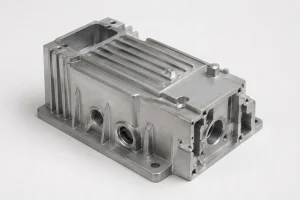
As part of the Al-Si-Cu alloy family, ADC12 is often used when cast parts require thin-wall filling, stable dimensions, and practical post-casting machining. It is commonly compared with A380, but the two grades belong to different standard systems and should be matched to the drawing requirement and material specification.
ADC12 Chemical Composition
The chemical composition of ADC12 is formulated to provide stable filling characteristics and mechanical performance for various engineering parts.
| Element | Reference range |
| Si | 9.6–12.0 % |
| Cu | 1.5–3.5 % |
| Fe | ≤ 1.3 % |
| Zn | ≤ 1.0 % |
| Mn | ≤ 0.5 % |
| Ni | ≤ 0.5 % |
| Mg | ≤ 0.3 % |
| Sn | ≤ 0.2 % |
| Al | Balance |
Silicon supports the alloy’s fluidity and its ability to fill complex mold geometries. Copper contributes to increased hardness, strength, and machinability. Iron, zinc, magnesium, and other elements should be controlled according to the required standard and certified material reports to maintain structural integrity.
ADC12 Mechanical Properties
Mechanical performance in ADC12 components is influenced by the casting process, mold design, wall thickness, porosity control, cooling rates, and relevant inspection requirements.
| Property | Reference value |
| Tensile strength | about 310 MPa |
| Yield strength | about 150 MPa |
| Elongation | about 3.5 % |
| Shear strength | about 210 MPa |
| Fatigue strength | about 140 MPa |
These values serve as reference data and should not be interpreted as guaranteed results for every production batch. Actual performance is verified through testing based on conditions unique to the cast component.
ADC12 Physical and Thermal Properties
| Property | Reference value |
| Density | about 2.68 g/cm³ |
| Melting range | about 515–582 °C |
Casting Processes for ADC12
ADC12 is widely used in high pressure die casting for complex aluminum components. Its good fluidity supports detailed features and thin-wall sections. The manufacturing route is reviewed according to part geometry, production volume, machining requirements, and quality specifications. Other casting processes require project-specific evaluation.
Gravity Casting
Gravity casting is suitable for ADC12 parts with relatively stable wall sections and mold structures that allow controlled metal flow and solidification. This route is often used for medium-size aluminum components, housings, covers, and structural parts where dimensional consistency and machining allowance need to be managed.
Low Pressure Casting
Low pressure casting is useful when ADC12 parts require controlled mold filling, improved feeding during solidification, pressure-tightness, or better internal quality control. It is commonly considered for castings with machined sealing areas, enclosed shapes, or higher inspection requirements.
Sand Casting
Sand casting can be used for ADC12 parts with larger dimensions, lower production volume, prototype needs, replacement requirements, or special structures. This route offers more tooling flexibility, while machining allowance and shrinkage control should be planned carefully.
High Pressure Die Casting
High pressure die casting is commonly used to manufacture ADC12 gearbox covers, motor housings, electronic enclosures, and brackets. The process supports efficient repeat production and consistent dimensions. Die design, venting, and injection settings are planned to control filling and porosity, while critical holes, threads, and mating surfaces can be CNC machined after casting.
ADC12 Casting Characteristics
This alloy is preferred for projects where material flow and geometric complexity are priorities.
- Castability: Exceptional fluidity facilitates the filling of thin walls and intricate internal features.
- Dimensional stability: Maintains structural form well during and after the solidification process.
- Machinability: Compatible with post-casting precision machining when allowances are properly planned.
- Production repeatability: Offers consistent performance in manufacturing cycles.
- Porosity sensitivity: Requires careful process control to manage internal defect risk.
Common Applications of ADC12 Castings
ADC12 is commonly used in industries that require complex aluminum castings, stable dimensions, and efficient production of medium to high-volume components.
- Automotive and transportation: transmission covers, gearbox covers, brackets, motor housings, and structural support parts.
- Electronics and electrical equipment: electronic housings, control boxes, connector housings, heat dissipation covers, and enclosure components.
- Industrial machinery: equipment covers, small machinery housings, mounting bases, and protective covers.
- Motor and power equipment: motor end covers, power tool housings, cooling-related castings, and mounting components.
- General engineering products: complex aluminum covers, brackets, thin-wall housings, and precision cast components.
Surface Finishing for ADC12 Castings
Finishing selection is determined by appearance, protection needs, assembly requirements, and the operating environment.
- Shot blasting: Cleans and unifies the surface appearance of the raw casting.
- Deburring: Removes excess material or sharp edges from the casting process.
- Powder coating: Provides a durable protective or decorative finish.
- Painting: Utilized for color coding or specific environmental protection.
- Machined sealing surfaces and mounting faces: Requires planning relative to casting tolerances and integrity.
- Project-specific surface preparation: Targeted treatments applied to meet unique application environments.
ADC12 Aluminum Casting Capabilities
At Minhe foundry, we support ADC12 aluminum casting production through careful preparation based on drawing specifications, material standards, wall thickness, and finishing needs. Our team analyzes technical details to ensure feasibility.
- ADC12 material analysis
- Casting process confirmation
- Surface finishing support
- Post-casting machining
- Inspection and quality control
FAQ
What is ADC12 aluminum alloy equivalent to?
ADC12 is often compared with A380, EN AC-46000, and other aluminum die casting alloys. These grades may be similar in application range, but they are not exact universal equivalents. Equivalency should be confirmed against the required standard, material specification, and certified material report.
What is the difference between ADC12 and A380?
ADC12 and A380 are both aluminum-silicon-copper casting alloys commonly used in die casting applications. ADC12 belongs to the JIS standard system and is common in Japan and many Asian manufacturing contexts, while A380 is widely used in North American specifications. Their applications may overlap, but composition limits and material standards are different.
What are the characteristics of ADC12?
ADC12 is known for good fluidity, dimensional stability, machinability, and repeatable casting performance. It is often used for complex aluminum parts, thin-wall castings, housings, covers, brackets, and components requiring stable dimensions.
What is the density of ADC12 aluminum?
The density of ADC12 aluminum is about 2.68 g/cm³. The value may vary slightly depending on the exact composition range and material standard used for the project.
What is the hardness of ADC12 aluminum?
ADC12 hardness is commonly listed around 80 HB in reference material data. Actual hardness may vary with casting conditions, wall thickness, cooling rate, and inspection method.