


Sand casting sand is a two-part material: the base sand that carries the heat of the molten metal, and the binder system that holds the grains together until the casting solidifies. Most foundries start with silica base sand and then choose between green sand, dry sand, water glass sand, and resin sand based on part complexity, precision, surface finish, and budget. Sand casting works with any of these systems, but the right combination changes the cost, accuracy, and defect risk of the part. This article separates the base sands from the molding systems, then gives a practical selection path for a real project.
What Is Sand Casting?
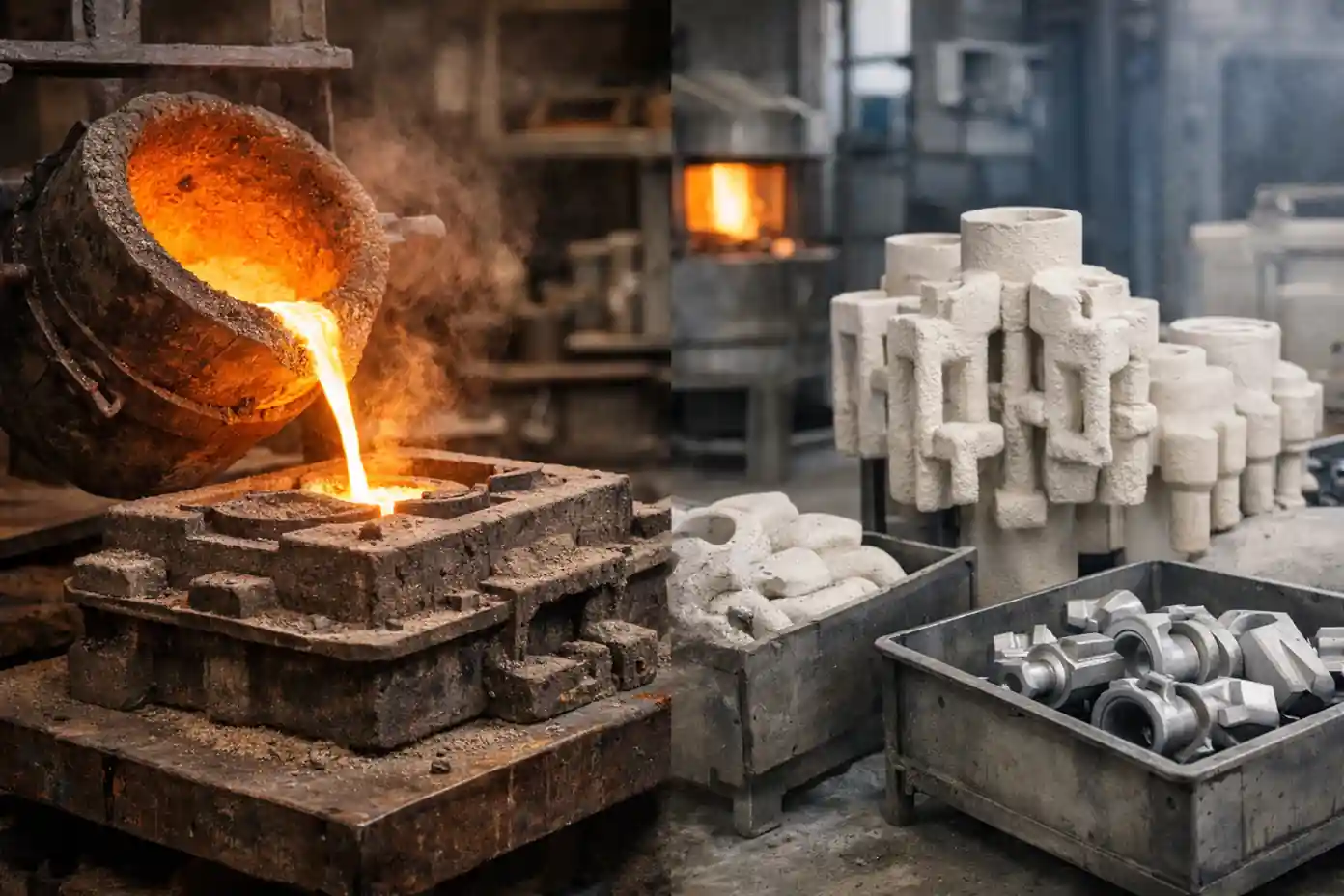
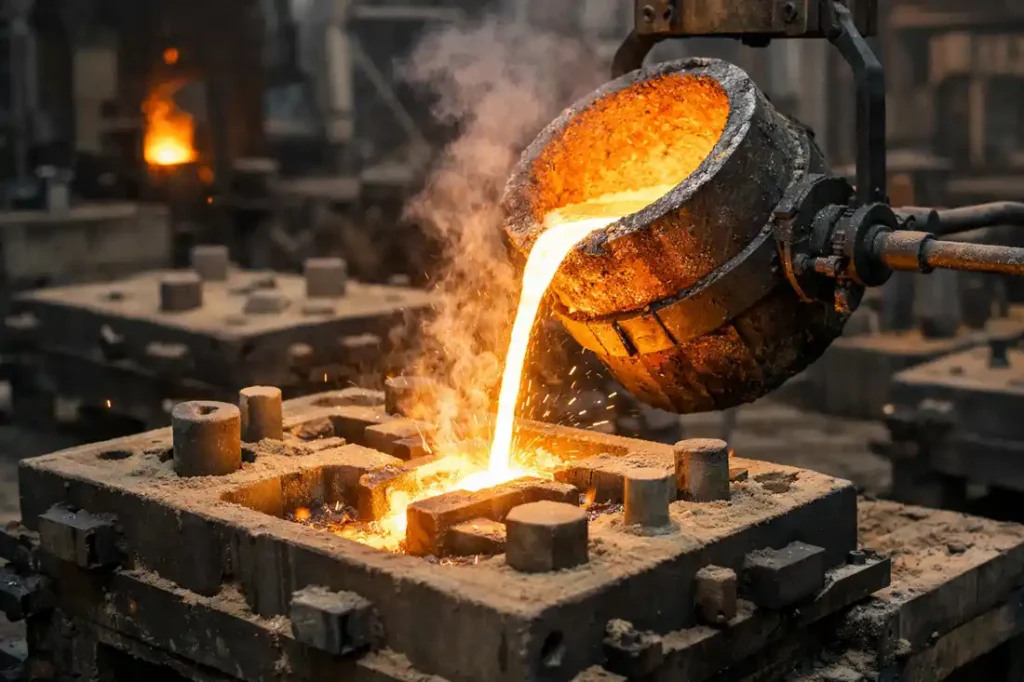
Sand casting is a metal casting process in which a pattern is used to form a cavity in sand, molten metal is poured into the cavity, and the mold is broken apart after solidification to release the part. It is an expendable-mold process: a new mold is made for every pour. That single fact explains why the sand matters so much—the mold is the tool, and it is rebuilt every cycle.
Sand casting covers a wide part-size range, from small housings to large machine bases, and works with cast iron, steel, aluminum, and copper alloys. Low tooling cost and design flexibility are why it remains the most widely used casting method in production.
Types of Base Sand Used in Sand Casting
Sand casting sand is made of two parts: the base sand that carries the heat of the molten metal, and the binder system that holds the grains together until the casting solidifies. So “type of sand” has two dimensions—the base sand itself and the molding system covered in the next section. The properties foundries care about, such as refractoriness, permeability, and strength, come from the combination of the two. Six base sands cover most foundry work.
Silica Sand (Quartz Sand)
Silica sand is mainly silicon dioxide (SiO₂). It has good refractoriness and chemical stability for iron and non-ferrous castings, but expands noticeably at high temperature. It is the default base sand because it is cheap and widely available.
Chromite Sand
Chromite sand has very high heat resistance and conducts heat fast, giving a chilling effect that suits steel castings and heavy sections. It costs more than silica.
Zircon Sand
Zircon sand offers the best dimensional stability of the group: high heat resistance and low thermal expansion, which is why it is used for precision cores, thin sections, and tight-tolerance steel castings. It is one of the most expensive options.
Olivine Sand
Olivine sand has higher heat resistance than silica and contains no free silica, making it a fit for manganese bronze, steel, and silica-dust-sensitive jobs at medium cost.
Garnet Sand
Garnet sand is hard and chemically stable, used for parts with specific surface requirements and some non-ferrous alloys.
Synthetic Sand
Synthetic sand is blended to a designed grain distribution and composition, giving consistent batch properties for production runs that depend on stable sand behavior.
Main Sand Molding Systems
The molding system—not the base sand—usually decides the name of the process and most of the cost and quality tradeoffs.
Green Sand
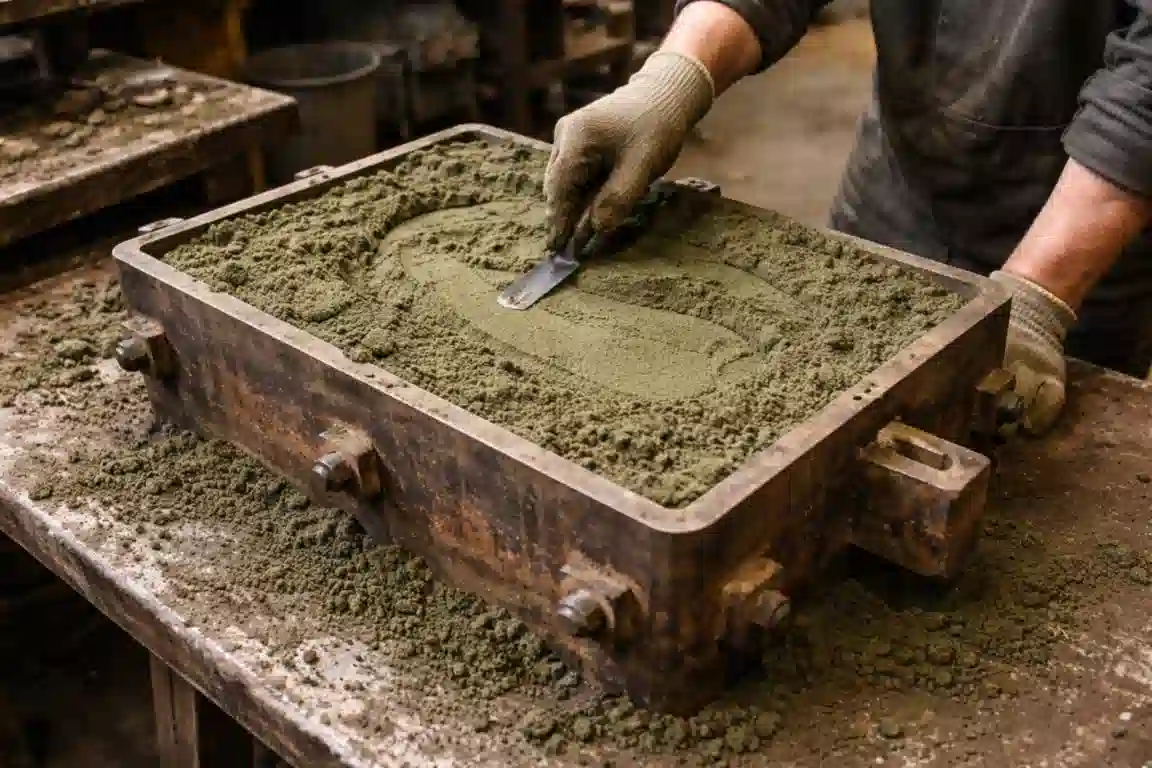
Green sand is a clay-bonded system: silica sand mixed with bentonite clay and water, poured while still moist. The word “green” does not refer to color; it means the mold is uncured and wet when the metal goes in. Green sand is the cheapest molding system, easy to compact, and highly recyclable, which makes it the standard for mass-producing machine bases, housings, brackets, and covers. The tradeoffs are real: dimensional accuracy and surface finish are the lowest of the main systems, so critical features usually need machining allowance. For the cost-sensitive majority of industrial parts, those limits are acceptable—green sand casting remains the foundation of sand casting production.
Dry Sand
Dry sand uses the same clay bonding as green sand, but the mold is baked after shaping. Baking raises mold strength and removes most of the moisture, so the mold gives off far less steam during pouring and holds the cavity shape more stably. It suits medium-sized castings and parts where steam or mold movement would be a problem. The extra baking step makes the cycle slower and slightly more expensive than green sand.
Sodium Silicate (Water Glass) Sand
Sodium silicate sand, also called water glass sand, is mixed with liquid sodium silicate and hardened by blowing CO₂ gas through the mold. The chemical reaction produces a rigid mold in minutes, without baking. It is a good fit for complex internal cavities and cores: the hardened mold holds its shape well, tolerances are better than green sand, and the cavity surface is cleaner. It is widely used in Chinese manufacturing for pump bodies, valve parts, and housings with internal passages. A practical advantage is breakdown: after pouring, the mold can be dissolved or flushed with hot water to release the casting, and the sand collected for reclamation.
Resin (No-Bake) Sand
Resin sand is a self-hardening no-bake system: the sand is mixed with resin and a catalyst that reacts at room temperature, so the mold gains high rigidity without heat or CO₂. It delivers the strongest, most dimensionally stable mold of the main systems, significantly reduces defects such as shrinkage porosity and gas holes, and produces accurate dimensions with clear surface detail. That makes it the preferred choice for heavy-duty industrial components, gearbox housings, and structural castings. The costs are real: resin and catalyst are more expensive than clay and water, and reclamation requires mechanical or thermal treatment. In exchange, scrap rate and post-casting machining drop, which often pays back the higher mold cost on precision parts.
Other Systems
Shell molding coats resin-bonded sand on a heated pattern to form a thin shell, giving high precision for small-to-medium batches; the V-Process holds dry sand under vacuum for clean surfaces on large parts; loam sand mixes clay and silica in roughly equal parts for large or special castings; cold-box and hot-box cores use resin cured by gas or heat for complex core geometries. On cost, strength, precision, and reuse, green sand is the cheapest with the lowest precision, dry sand sits in the middle, water glass sand offers higher precision at moderate cost, and resin sand is the most precise and most expensive—final levels depend on the foundry’s actual process.
Sand Casting Process Step by Step
The complete sand casting process runs in seven steps, and every step is tied to the sand itself.
Pattern and Sand Preparation
Build the wood or metal pattern and prepare the molding sand. Grain size and binder ratio are set here, and they drive everything that follows.
Core Making and Placement
For parts with internal cavities, make sand cores and set them in the mold. Core permeability and strength decide the quality of the internal geometry.
Mold Assembly
Close the cope and drag, leaving the gating system and risers in place, and check the parting line.
Melting and Pouring
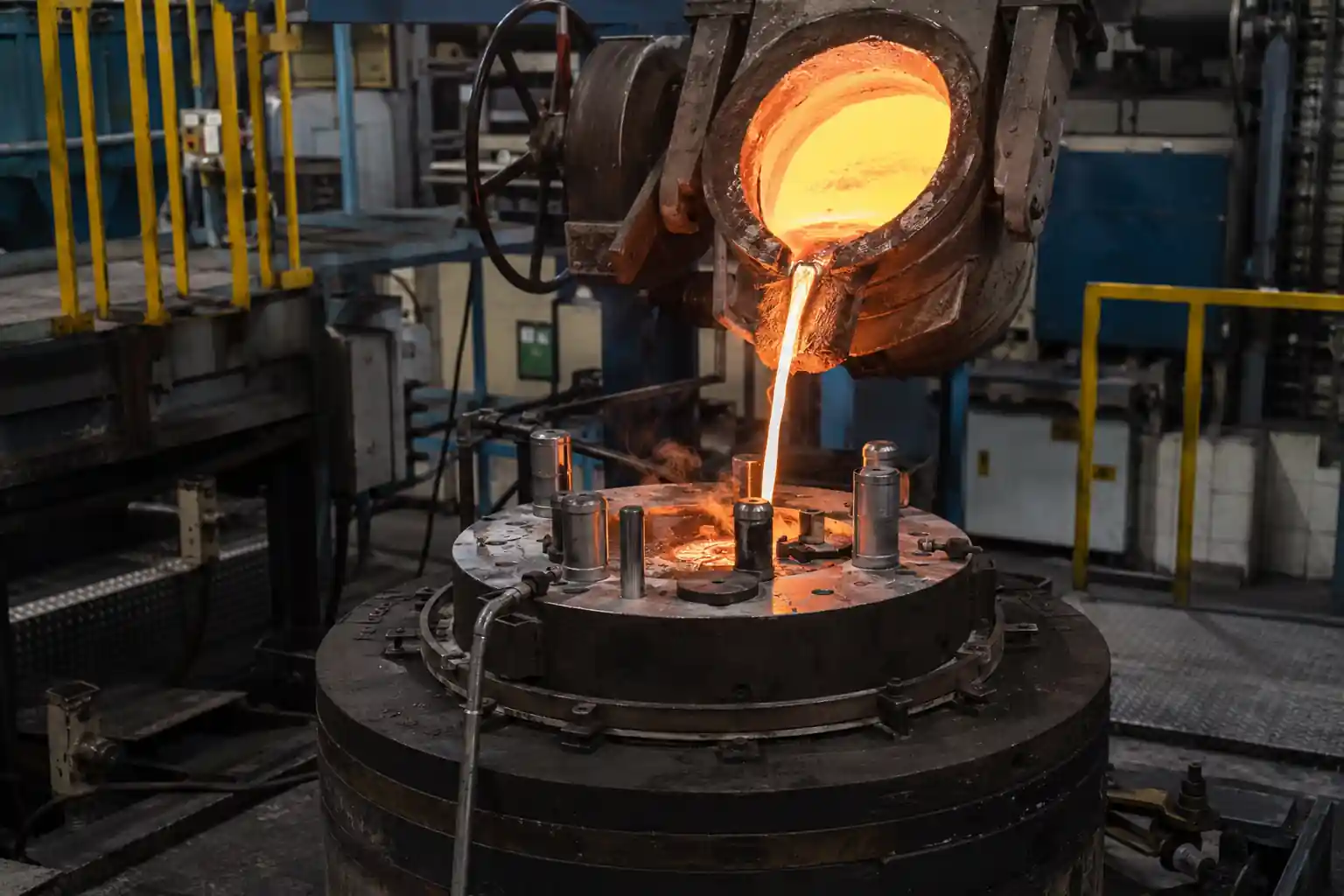
Control the melt and pouring temperature for the alloy and fill the cavity steadily to avoid air entrainment and sand wash.
Cooling and Solidification
Allow enough solidification time to control shrinkage; the mold’s heat extraction shapes the final structure.
Shakeout and Cleaning
Break the mold, remove the casting, and clean off sand, gates, and risers.
Post-Processing and Inspection
Machine, heat treat, or test as the part requires; parts with high surface expectations get finishing first.
Sand quality runs through every step:
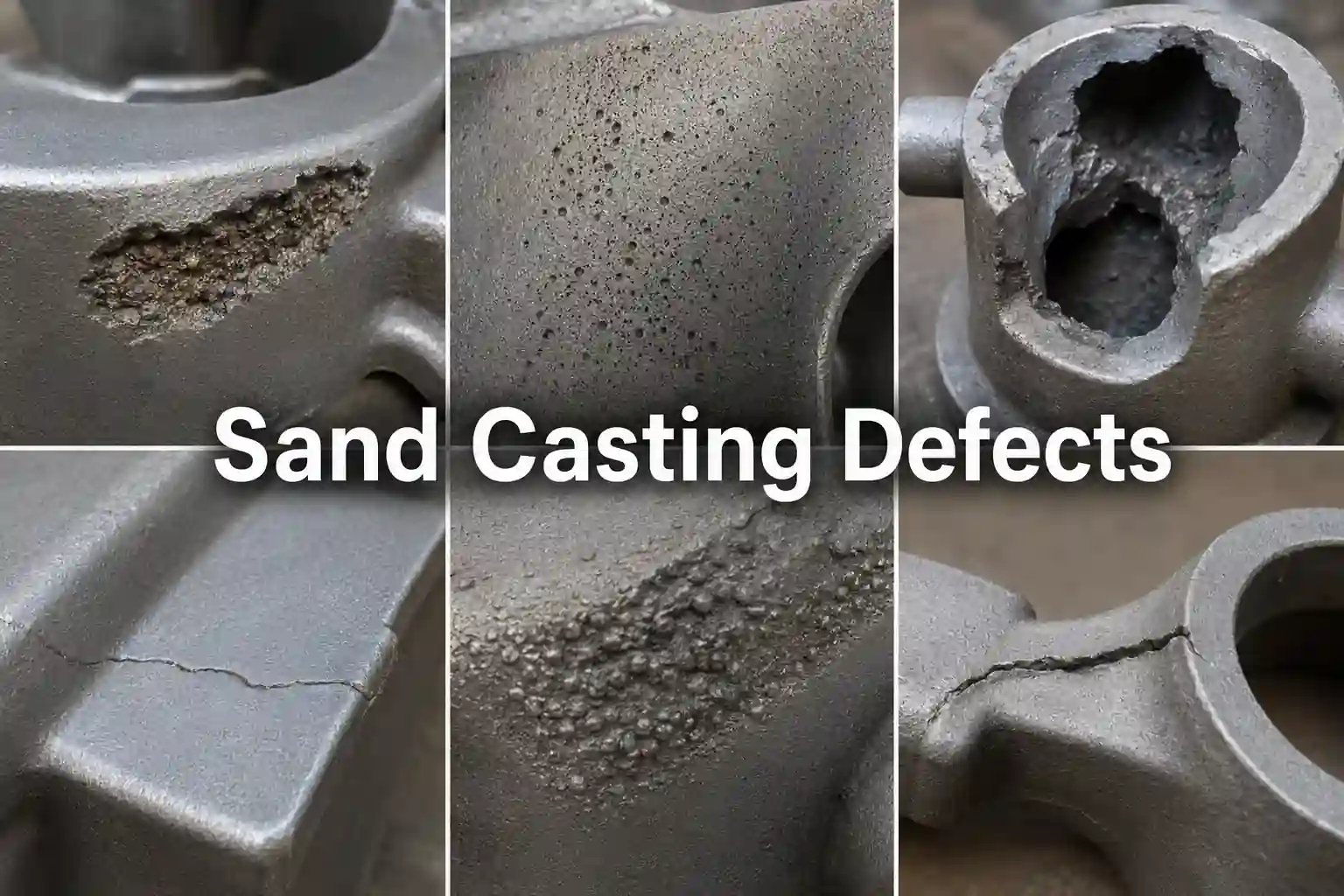
- Low permeability traps gas and causes porosity
- Weak molds collapse or shift
- Uneven compaction shows up as dimensional error
Advantages and Limitations
Advantages
- Low tooling cost, friendly to prototypes and small batches
- Wide part-size range, including large castings
- Broad material compatibility: iron, steel, aluminum, and copper alloys
- Flexible pattern changes for design iteration
Limitations
- Rougher surface finish; visible parts usually need post-processing
- Lower dimensional accuracy than permanent-mold or die casting; critical features need machining allowance
- Thin walls and fine details are harder to fill; process control matters
- A new mold per pour, so cycle time per part is not competitive with die casting at very high volume
Applications of Sand Casting
Sand casting’s typical applications sit in structural and fluid-handling parts:
- Machine bases and beds
- Pump and valve bodies
- Gearbox housings
- Automotive and agricultural structural parts
Aluminum castings are also commonly produced by sand casting for small-to-medium batches of structural parts.
Frequently Asked Questions
What are the main types of sand casting? The four main systems are green sand, dry sand, water glass sand, and resin sand; shell molding, the V-Process, loam, and cold-box or hot-box cores cover specific situations.
What is the difference between dry sand and green sand? Dry sand is a clay-bonded mold that is baked after shaping. Baking raises strength and removes moisture, so the mold gives off less steam during pouring, at the cost of a slower cycle.
Which sand molding method gives the best precision and surface? Resin sand gives the highest precision and surface quality, water glass sand sits in the middle, and green sand is the lowest; when precision dominates, resin sand is usually the first choice.
Is sand casting suitable for mass production? Green sand handles medium-to-high volumes of general parts well; at very high volume with thin walls and tight tolerances, die casting or permanent-mold casting wins on cycle time.
Which is better, water glass sand or resin sand? Neither wins outright. Water glass sand is cheaper and suits complex internal cavities; resin sand gives the highest strength and precision but costs more. The choice follows the part’s precision and budget.
How do I choose the right sand and mold for my casting? Weigh batch size, precision and surface, cost, then special alloy requirements. Green sand suits standard shapes and medium-to-high volume; water glass sand suits complex cavities and pressure-tight parts; resin sand suits heavy-duty parts with tight dimensions. For steel and heavy sections, check the base sand separately—chromite or zircon may be a better fit than silica.
Conclusion
Sand casting sand is a two-part decision: pick the base sand that handles the alloy and section thickness, then pick the molding system by batch size, precision, surface, and cost. Green sand covers the cost-sensitive majority, dry sand balances strength and steam control, water glass sand handles complex cavities, and resin sand sets the standard for heavy-duty quality. Check the base sand separately for steel and heavy sections, and weigh batch size against precision before choosing. If you are evaluating a part, send us the material, tolerance, and volume—our sand casting services team will shortlist the right sand system for your project.