


ADI is ductile iron with one important upgrade: an austempering heat treatment that roughly doubles its usable strength and gives it wear resistance closer to hardened steel. It still casts like ductile iron, so you keep the design freedom of a casting, but the part comes out strong enough for gears, mining wear parts, and agricultural components that would normally push you toward a forging. This guide covers what ADI is, how the process works, which grades to specify, and what it actually costs to use.
What Is Austempered Ductile Iron?
ADI starts as ordinary ductile iron straight from the foundry. The difference is a controlled heat treatment step applied after casting. The part is heated into the austenite range, quenched to the bainite transformation zone, and held there for a set period. During that hold, the matrix transforms into acicular ferrite and carbon-enriched austenite. That microstructure is what gives ADI its combination of high strength, toughness, and wear resistance.
ADI is not a new alloy, and it is not a different grade of iron. It is the same ductile iron chemistry you already know, upgraded by process control. That distinction matters because it keeps material cost predictable; most of the added cost sits in the heat treatment and the machining that follows.
How Is ADI Made? The Austempering Process
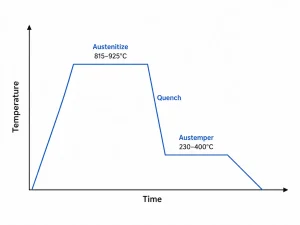
The process has three stages, and each one changes the final properties:
- Austenitizing – heat the casting to roughly 815-925°C so the matrix becomes fully austenitic and carbon dissolves completely
- Quenching – cool the part rapidly to the austempering window, usually 230-400°C, to avoid pearlite formation
- Isothermal holding – hold at temperature until the matrix transforms to acicular ferrite and carbon-enriched austenite, then cool to room temperature
The austempering temperature is the main lever. Lower temperatures (around 230-290°C) produce higher strength and hardness at the cost of ductility. Higher temperatures (350-400°C) trade some strength for better elongation and impact toughness. Holding time also matters, but temperature is where the grade gets set.
Because the transformation depends on cooling rate, wall thickness drives the process design. Thin and thick sections cool differently, which is why ADI castings need more attention to section uniformity than ordinary ductile iron. Your foundry should confirm the target grade is achievable for your specific wall thickness before tooling starts.
ADI Grades and Mechanical Properties
ADI grades are written as tensile strength / yield strength / elongation. The standard frameworks are ASTM A897 and ISO 17804, and the five common grades look like this:
| Grade | Tensile Strength (MPa) | Yield Strength (MPa) | Elongation (%) | Typical Hardness (HBW) |
|---|---|---|---|---|
| 900/650/09 | about 900 | about 650 | about 9 | 269-341 |
| 1050/700/07 | about 1050 | about 700 | about 7 | 302-363 |
| 1200/850/04 | about 1200 | about 850 | about 4 | 341-444 |
| 1400/1100/02 | about 1400 | about 1100 | about 2 | 388-477 |
| 1600/1300/01 | about 1600 | about 1300 | about 1 | 402-512 |
Pick the grade from the loading, not from the biggest number. The 900 grade balances strength and toughness and is the easiest to machine. The 1600 grade is a wear-first material; it will not give you ductility, and machining it is slow and expensive.
ADI vs. Conventional Ductile Iron
The honest comparison comes down to four things: strength, wear resistance, cost, and machinability.
| Property | Conventional Ductile Iron | ADI |
|---|---|---|
| Tensile strength | 400-800 MPa typical | 900-1600 MPa |
| Wear resistance | Moderate | Close to quenched steel |
| Elongation | 2-18% depending on grade | 1-9%, drops at high grades |
| Relative cost | Baseline | + heat treatment and machining cost |
| Machinability | Easy | Hard; more tool wear and longer cycles |
Conventional ductile iron is the right answer for bending, torsion, and impact-loaded parts where strength stays under its range. ADI earns its premium when the part sees heavy friction, high contact stress, or repeated load cycles. If the part has no real wear requirement, pay for the ductile iron grade that meets the load and stop there.
Typical Applications of ADI Castings
ADI shows up wherever a casting needs forged-steel-level performance:
- Gears and drivetrain parts – agricultural gears, gearbox gears, sprockets
- Mining and crushing – liners, wear plates, hammer components, jaw parts
- Agricultural machinery – plow points, gearbox housings, suspension arms
- Rail and heavy vehicles – bogie components, brake parts, couplers
- General engineering – crankshafts, camshafts, high-strength brackets and housings
The pattern is consistent: complex geometry, meaningful volume, and a part that fails from wear or fatigue if made in ordinary ductile iron. For those parts, ADI often beats forged steel on cost and machining convenience.
Design and Procurement Considerations
Before you put ADI on the drawing, settle these four points:
Wall thickness and uniformity. Austempering is cooling-rate sensitive. Keep sections uniform and confirm thick sections with the foundry. A 25 mm boss next to a 6 mm wall will not transform the same way unless the process is designed around it.
Machining allowance. ADI machines nothing like ordinary ductile iron. Hardness in the 300-500 HBW range wears tools fast. Leave generous allowance on critical surfaces and confirm the machining plan with your supplier early. Trial cutting before production is strongly recommended.
Grade specification. Write the grade on the drawing, for example 1050/700/07 per ASTM A897, and agree the mechanical test method for acceptance. Leave the grade open and you will get whatever the foundry finds easiest to produce.
Total cost. ADI cost equals the ductile iron blank, plus the heat treatment, plus higher machining cost. Compare that total against a forging or a surface-hardened ductile iron part before you commit. In many cases ADI wins; in some it does not, and the only way to know is to price the full chain.
FAQ
Which is stronger, ADI or ductile iron?
ADI, clearly. Typical ductile iron tensile strength runs 400-800 MPa depending on grade, while ADI reaches 900-1600 MPa with better wear resistance. The gap is roughly double.
Can ADI be machined?
Yes, but expect slower cutting and faster tool wear than ordinary ductile iron. Leave machining allowance, plan the tooling early, and run a trial cut before full production.
Is ADI cheaper than forged steel?
Usually, for complex shapes. ADI starts as a casting, which avoids forge dies and the forging operation itself. The gap narrows when the part is simple or needs a lot of machining, so price the full chain rather than assuming.
Is ADI suitable for thin-wall castings?
With limits. The austempering transformation depends on cooling rate, so very thin or highly variable walls can produce inconsistent structure. Confirm the wall thickness range with your foundry before design freeze.
Conclusion
ADI is a practical way to get forged-steel-level strength and wear resistance while keeping the design freedom and cost structure of a casting. Use it where the part is complex, the volume is real, and the loading justifies the premium. Specify the grade, keep the walls uniform, and price the machining before you commit. If you have a part drawing and want a straight answer on whether ADI makes sense, send it to our casting team and we will work through the grade, the heat treatment, and the machining together.