


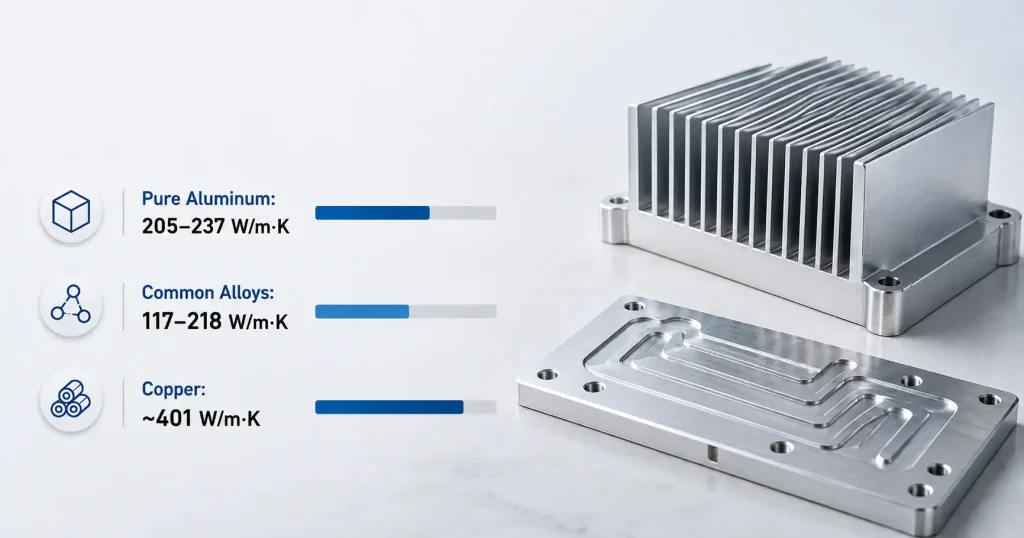
Pure aluminum has a thermal conductivity of 205–237 W/m·K, behind only silver and copper among common metals. Alloy grades drop to roughly 117–218 W/m·K. But the peak ranking is not the whole story: per unit mass, aluminum moves about 1.4 times more heat than copper, which is why heat sinks, cold plates, and heat exchangers are so often built from it. Selection comes down to three things — the value at your operating temperature, the strength-versus-conductivity trade-off, and the alloy that fits the application.
What Makes Aluminum an Exceptional Thermal Conductor
Metals conduct heat mainly through free electrons. Electrons moving through the crystal lattice carry heat from the hot side to the cold side; the fewer collisions they meet, the better the material conducts. Pure aluminum has a uniform lattice and very few impurities, so electrons travel almost unobstructed and both its thermal and electrical conductivity stay high. Alloying changes that: dissolved elements act as scattering centers, electrons get knocked off course, and conductivity drops.
How Free Electrons Carry Heat
Thermal and electrical conduction share the same free electrons, so they usually rise and fall together. Pure aluminum reaches close to 237 W/m·K, roughly 60% of copper. The practical rule that follows: any addition that seriously degrades aluminum’s electrical conductivity will compress its thermal conductivity in roughly the same proportion.
Thermal Conductivity vs. Thermal Diffusivity
The two values answer different questions. Thermal conductivity (k) tells you how much heat can flow in steady state — the number to use for sizing a heat sink. Thermal diffusivity (α) tells you how fast a temperature change spreads — whether the part warms up evenly or runs hotspots. Aluminum’s α is about 91 mm²/s, an order of magnitude above stainless steel, which is why aluminum heat sinks warm up fast and stay even. Size the steady state with k; check α when warm-up time or hotspots matter.
Thermal Conductivity Values Across Aluminum Alloy Series
The values below are steady-state measurements at room temperature (20–25°C). W/m·K states how many watts pass through a 1 m cube of material per degree of temperature difference; expect a few W/m·K of variation between supplier data sheets and size against the grade’s own data.
Aluminum Alloy Thermal Conductivity Reference Table
| Material | Thermal conductivity (W/m·K) | Notes |
|---|---|---|
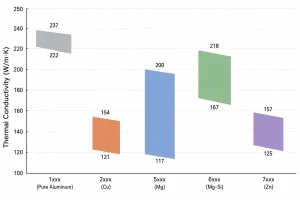
| Pure aluminum (1xxx) | 222–237 | 1050 ≈ 229, 1100 ≈ 222; best conduction, lowest strength |
| 3003 (3xxx) | 163–193 | Manganese alloy; moderate strength with modest loss |
| 5052/5083 (5xxx) | 117–200 | Conductivity falls as magnesium rises; good corrosion resistance |
| 6061-T6 (6xxx) | ≈ 167 | The usual balance of strength and conduction |
| 6063-T5 (6xxx) | 200–209 | Common for extruded heat sink fins |
| 7075 (7xxx) | 125–157 | Aerospace strength at the biggest conductivity cost |
| Pure copper (reference) | 385–401 | Roughly 60–70% higher than aluminum |
| 304 stainless steel (reference) | 14–25 | Only 1/10 to 1/15 of aluminum |
The 1xxx series conducts best but is too soft for structural parts; the 6xxx series conducts less but can carry load while dissipating heat, which is why it dominates real heat sink structures.
How Temperature Changes the Numbers
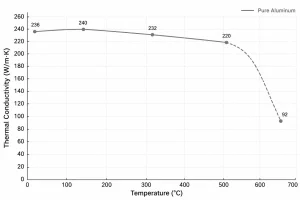
Temperature is the easiest value to overlook. Pure aluminum runs from about 236 W/m·K at 0°C to 220 at 527°C, rising before it falls, then drops sharply to about 92 W/m·K once molten. Room-temperature data only represents steady-state values at 20–25°C, so pull the number at your actual operating temperature.
Factors Affecting the Thermal Conductivity of Aluminum Alloys
Alloy composition and heat treatment set the value for a given grade; operating temperature decides which value applies. Alloying spreads pure aluminum’s 205–237 W/m·K into the series ranges, and heat treatment shifts the number within a grade.
How Alloying Elements Affect Thermal Conductivity
Alloying elements improve strength, corrosion resistance, or formability — and every one of them lowers conductivity to some degree:
- Copper: large strength gains at a real conductivity cost; the basis of aerospace 2xxx alloys
- Silicon: good flow for die casting, but clearly lowers conductivity in solution
- Magnesium: corrosion resistance and weldability; higher content costs more conduction, and high-magnesium 5xxx grades lose the most
- Zinc: the source of 7xxx strength and the heaviest conductivity penalty
The effect is quantifiable: pure aluminum sits at about 237 W/m·K and 6061-T6 at about 167, a difference of roughly 40%.
How Heat Treatment Changes Thermal Conductivity
The same grade changes value with temper: 6061-O is about 180 W/m·K and 6061-T6 about 167. O is the annealed condition; T4/T5/T6/T7 correspond to different solution and aging treatments, and the resulting precipitation state changes conductivity. Always compare data sheets with the temper suffix attached.
Aluminum Against Copper, Steel and Other Thermal Conductors
Among common metals, silver leads at about 428 W/m·K, copper runs 385–401, aluminum 205–237, and 304 stainless steel only 14–25.
When Copper Beats Aluminum
Copper conducts about 2.3 times as much heat as 6061 aluminum in steady state, which makes it the answer at high power density, in tight spaces, and under high heat flux — thin spreaders, bus bars, IGBT base plates. The cost is density far above aluminum’s and higher material price. When the two are combined, the usual hybrid is an aluminum body with copper tubes or inserts: copper carries the high-flux path, aluminum provides the lightweight structure.
304 stainless steel plays a different role entirely: it conducts only 1/10 to 1/15 as well as aluminum, and steel is chosen for corrosion resistance and strength, not conduction.
Weight-Normalized: Aluminum Wins
Divide conductivity by density and the picture flips. For weight- and cost-sensitive designs such as heat sinks and cold plates, this comparison is the one that matters:
| Material | Conductivity (W/m·K) | Density (g/cm³) | k/ρ (W·cm³/(m·K·g)) | Role |
|---|---|---|---|---|
| Pure aluminum | 205–237 | 2.70 | 62–76 | Heat sinks, cold plates, exchangers; weight advantage |
| Copper | 385–401 | 8.96 | 43–45 | High-power, space-constrained applications |
| Carbon steel | 45–58 | 7.85 | 5.7–7.4 | Low-cost industrial structures |
| 304 stainless steel | 14–25 | 8.00 | 1.9–3.8 | Corrosion resistance and strength |
| Titanium | ≈ 22 | 4.51 | 4.9 | Aerospace lightweighting |
Aluminum’s specific conductivity is about 1.4 times copper’s (62–76 vs 43–45).
Industrial Applications Leveraging Aluminum Thermal Properties
Aluminum’s thermal performance shows up across heat exchange and cooling, electronics and electrical, and automotive and aerospace; electronics cooling is its largest application category.
Heat Exchangers and Cooling Systems
Plate-fin and tube-fin heat exchangers use aluminum across HVAC, refrigeration, and industrial processing. Brazed 3003/4343 aluminum radiators have largely replaced copper–brass designs at 40–50% lower weight, and the 3xxx series balances brazing formability with corrosion resistance for volume heat-exchange cores.
Electronics and Electrical Applications
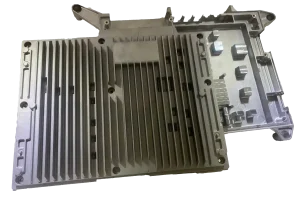
Electronics cooling is aluminum’s largest category — LED, servers, automotive electronics, and industrial equipment, commonly with 6063-T5; electrical bus bars use 6101-T6. Aluminum wins on extruded fin geometry and specific conductivity (k/ρ, higher than copper; see the comparison table), but total heat sink resistance is set by the interface, fin area, and airflow as much as by material conductivity; high-power designs often add heat pipes or copper inserts.
Automotive and Aerospace
Automotive electronics and EV battery thermal management use aluminum cold plates, with 6061-T6/6063-T6 balancing strength. Aerospace heat exchangers trade conductivity for weight with 2024-T3/7075-T6.
Conclusion
The selection sequence is straightforward: fix operating temperature and heat flux first, then mechanical requirements, then settle the grade by value and cost. Pull conductivity at the actual service temperature; evaluate copper or copper–aluminum hybrids at high power; use 6061-T6 where the part must carry load and 6063-T5 or 1100 for pure thermal shapes; keep thick coatings off heat paths and compare data sheets with temper suffixes attached.
If your thermal part needs to be cast or machined in volume, send us the drawing — we will work through the grade and the cost against your actual duty.
Frequently Asked Questions
What is the thermal conductivity of aluminum?
Pure aluminum runs 205–237 W/m·K; common alloys range from about 117 to 218 W/m·K depending on grade and temper.
What is the thermal conductivity of 6061 aluminum?
6061-T6 is about 167 W/m·K; 6063-T5 about 200–209 W/m·K.
Which conducts heat better, aluminum or copper?
Copper conducts 60–70% more in steady state, but per unit mass aluminum dissipates about 1.4 times more heat.
Which conducts heat better, aluminum or stainless steel?
Aluminum conducts 10–15 times better than 304 stainless steel (205–237 vs 14–25 W/m·K); stainless is chosen for corrosion resistance and strength, not conduction.
Why do aluminum alloys conduct less heat than pure aluminum?
Alloying elements dissolve into the lattice and become scattering centers, shortening the mean free path of the free electrons. The 1xxx series runs 222–237 W/m·K; the 7xxx series drops to 125–157 W/m·K.