


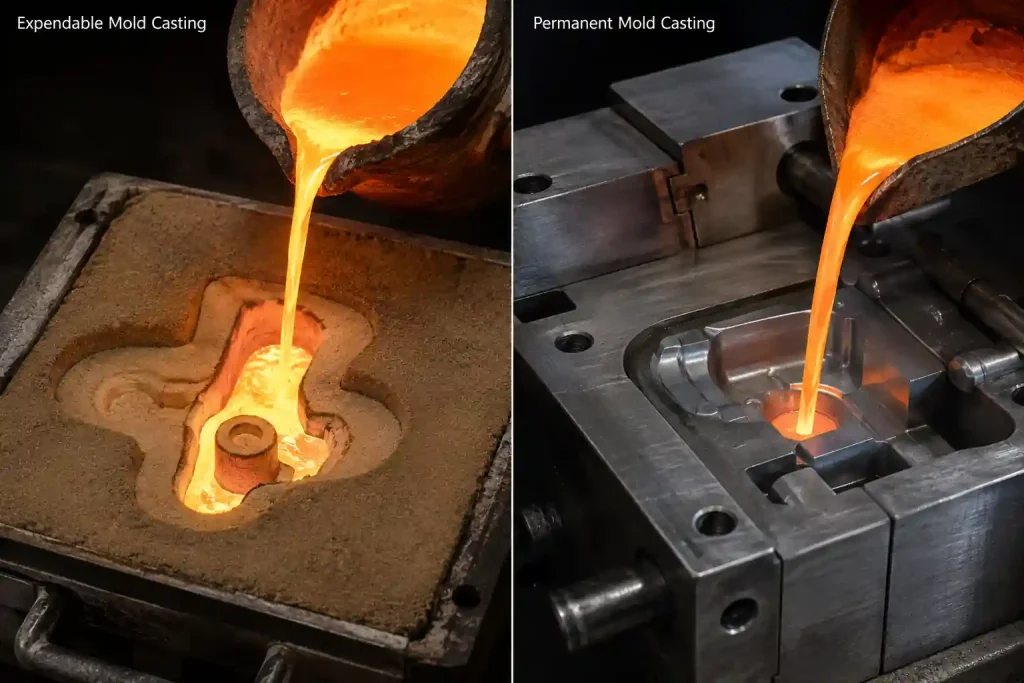
The same part can have very different tooling costs, production cycle times, and dimensional consistency depending on whether an expendable mold or a permanent mold is used. The former requires a new mold after each pour, while the latter uses a reusable metal mold. This article starts with the basic characteristics of the two processes, compares their differences in mold life, precision, materials, and production efficiency, and further explains how production volume and cost affect the final choice.
What Is Expendable Mold Casting?
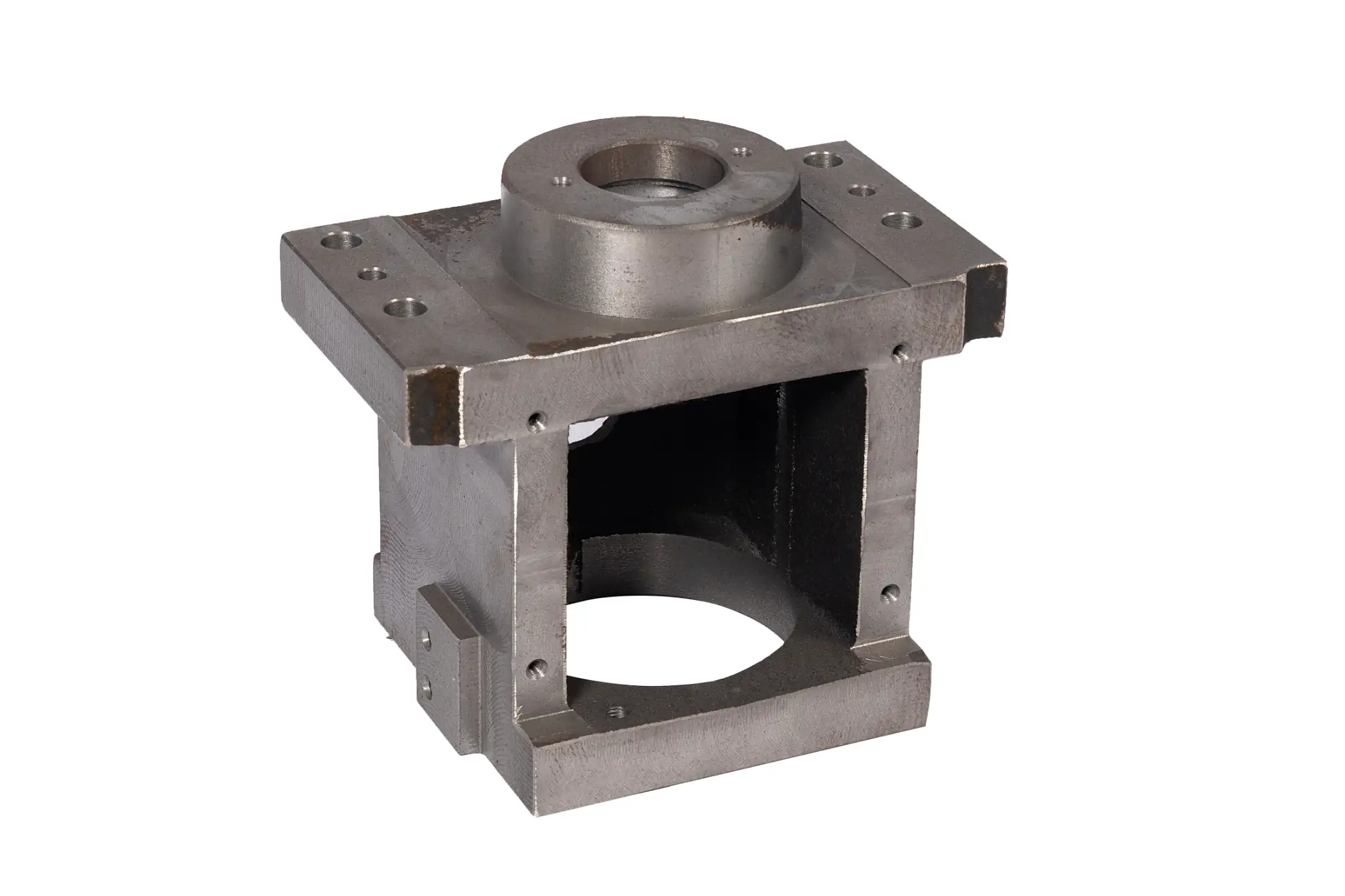
Expendable mold casting means that each mold can produce only one casting: once the casting is removed, the mold is destroyed. Sand casting, investment casting, shell molding, and lost-foam casting all belong to this category. Their common characteristic is that the molds are made from inexpensive materials such as sand, wax, or plaster and can only be used once.
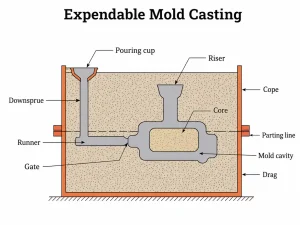
A typical process includes six steps:
- Mold making: use molding sand or wax to form a cavity with the same shape as the part.
- Closing: assemble and secure the cope and drag, or the shell.
- Pouring: pour molten metal into the cavity.
- Cooling: allow the metal to solidify inside the mold.
- Mold breaking: break the mold to remove the casting.
- Cleaning: remove gates, risers, and adhered sand.
Because a new mold must be made for every casting, the tooling itself is inexpensive, part size has almost no upper limit, and nearly any castable alloy can be used. However, the production cycle is longer because every part requires its own mold, and dimensional accuracy and surface quality are also lower than those of metal molds. Large parts, one-off orders, and extremely complex shapes often have no alternative.
What Is Permanent Mold Casting?
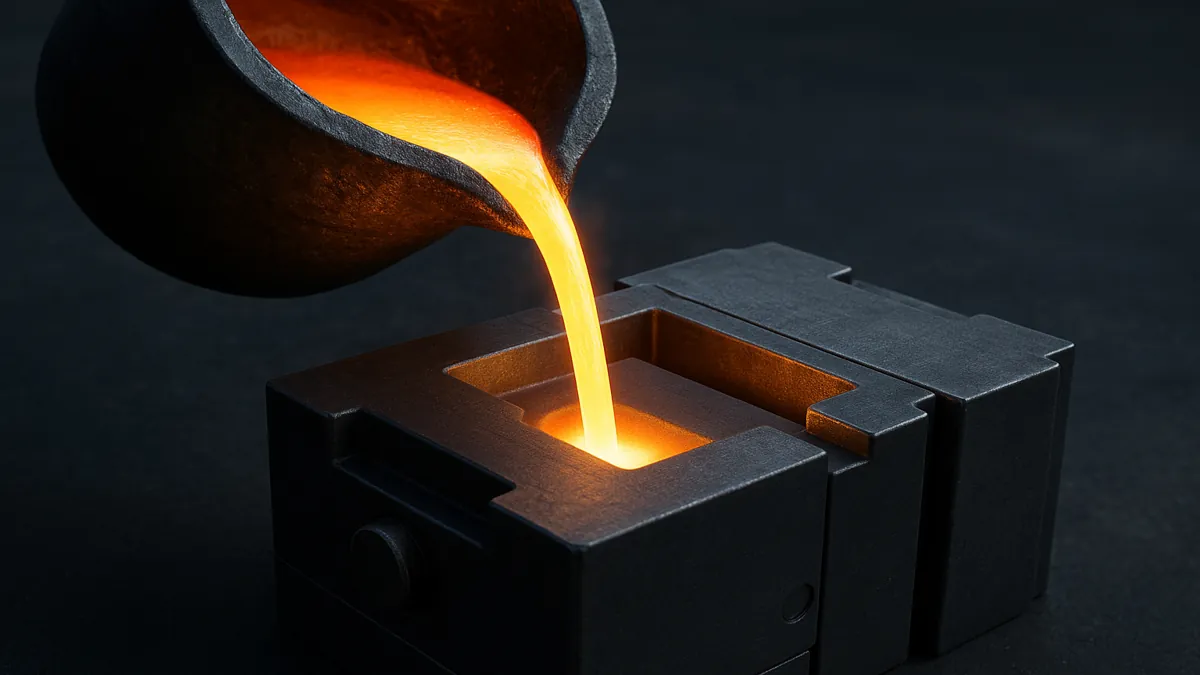
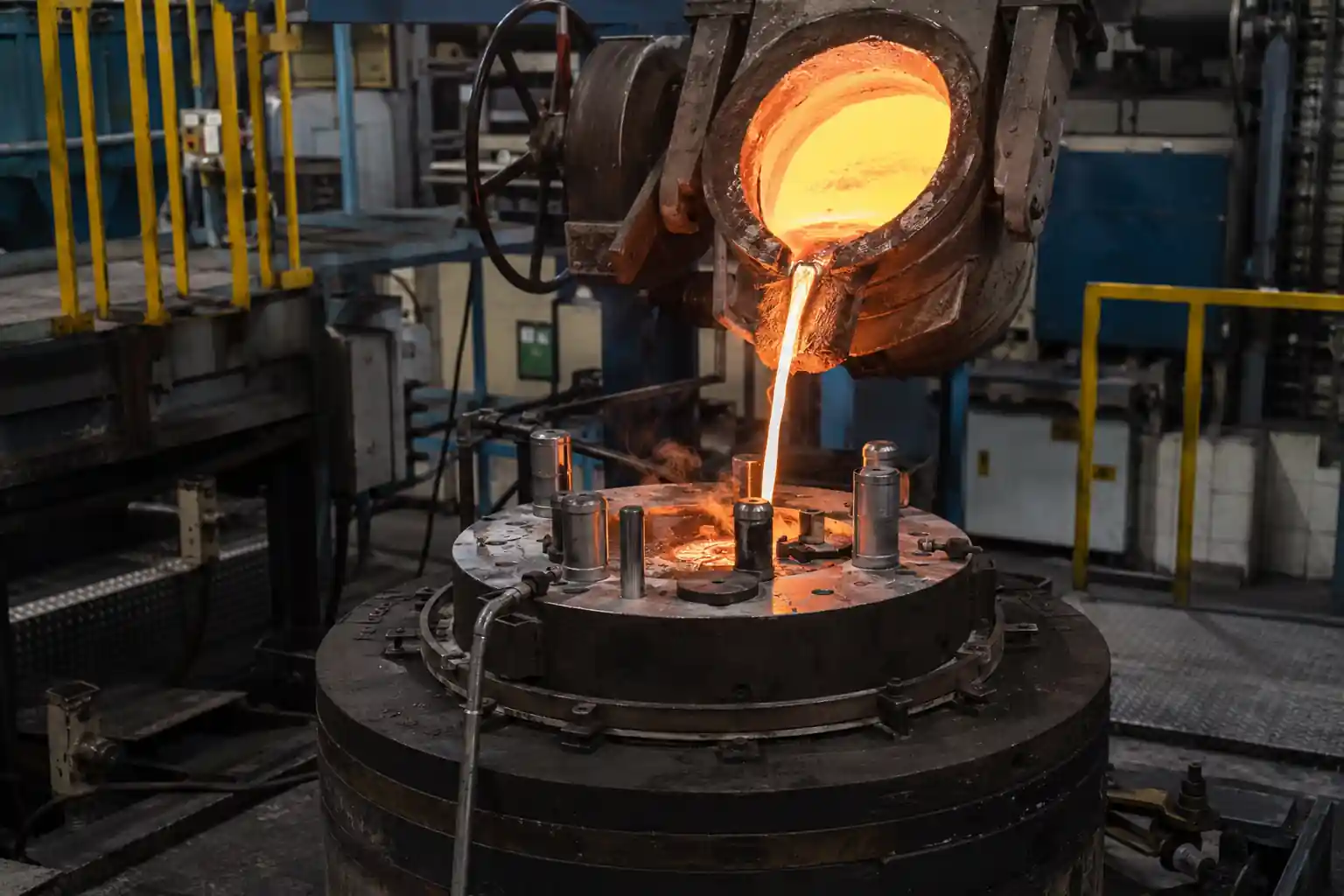
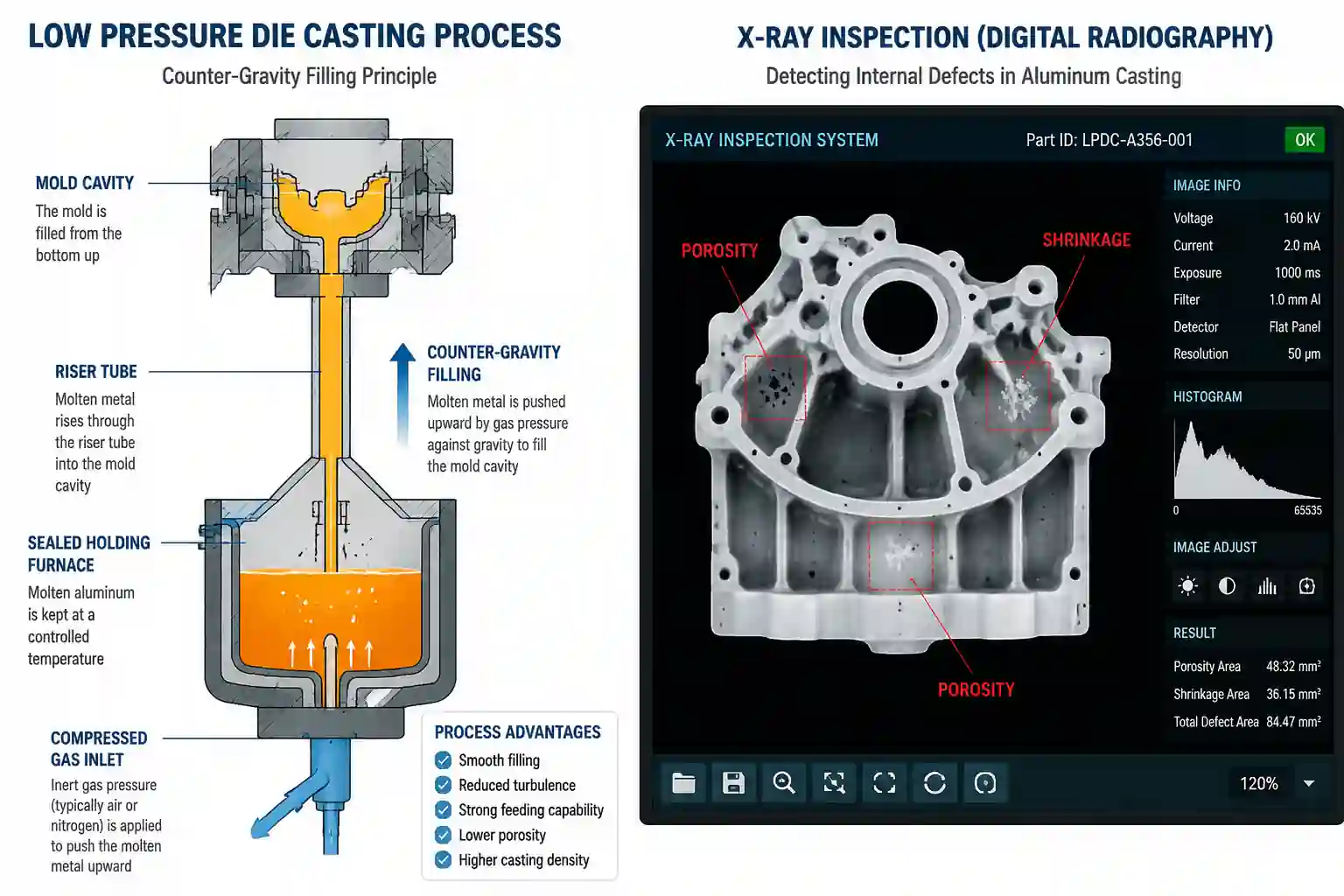
Permanent mold casting uses reusable metal molds made of steel, cast iron, or graphite. Gravity die casting, low pressure die casting, and high pressure die casting all fall into this category; they differ only in the way metal fills the cavity—by gravity, low pressure, or high-pressure injection.
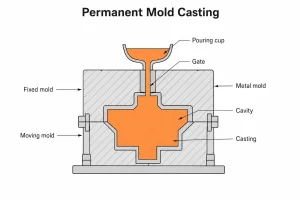
A typical production cycle is as follows:
- Preheat the mold and apply release agent.
- Close the mold.
- Pour or pressure-fill the cavity.
- Maintain pressure until the metal solidifies.
- Open the mold and remove the casting.
- Start the next cycle.
Metal molds conduct heat rapidly, so castings cool evenly and develop a finer grain structure. This is why the strength, density, and surface quality of metal-mold castings are generally better than those of sand castings. Mold life can typically reach thousands to tens of thousands of cycles, and most aluminum parts weigh less than 10 kg; the larger the part, the higher the mold and equipment costs and the less favorable the economics become.
What Is the Core Difference Between Expendable Mold Casting and Permanent Mold Casting?
| Comparison | Expendable Mold Casting | Permanent Mold Casting |
|---|---|---|
| Mold life | One mold per casting | Thousands to tens of thousands of cycles |
| Dimensional tolerance | Wider: sand casting roughly ±0.5–2.5 mm | Tighter: approximately ±0.25–0.8 mm for small and medium parts |
| Surface finish | Sand casting Ra 12.5–25 µm | Approximately Ra 3.2–6.3 µm |
| Castable materials | Almost any metal, including steel and cast iron | Mainly aluminum, zinc, magnesium, and copper alloys |
| Part size | From tens of grams to several tons | Usually below 10 kg |
| Tooling cost | Low | High: significantly higher than sand patterns |
| Cycle time | Slow: mold making takes the most time | Fast: suitable for continuous batch production |
| Typical applications | Pump bodies, valve bodies, large machine parts, art castings | Wheels, cylinder heads, motor housings, brake components |
Whether the mold can be reused determines the cost structure. Expendable casting spreads the cost across every part, while permanent mold casting concentrates the cost before the first pour. Therefore, expendable molds are more suitable for small-batch production, while permanent mold casting only shows its advantages when production volume is high enough to spread the tooling cost.
Material Differences: Which Alloys Suit Which Process?
Material is the first filter because some metals are never used with permanent molds.
- Aluminum, zinc, and magnesium: both processes are feasible; permanent mold casting is the mainstream choice.
- Copper alloys: permanent molds can be used, but mold life and cost must be considered carefully.
- Steel and cast iron: almost entirely use expendable molds. Their melting points are high, so metal molds wear quickly and the economics of mold life become unfavorable.
- Superalloys: mainly use expendable processes such as investment casting.
The rule is simple: the higher the melting point, the shorter the service life of a permanent mold and the more difficult it becomes to amortize the cost. Aluminum is currently the most mature material for permanent mold casting, which is why wheels and cylinder heads are almost always produced by low pressure die casting or permanent mold processes.
Advantages and Limitations of Each Process
Advantages of Expendable Mold Casting
- Low tooling cost: highly suitable for small-batch production, prototyping, and one-off parts.
- Nearly unlimited shape freedom: complex recesses and curved surfaces are not a problem.
- Wide part-size range: large parts almost always use this approach.
- Compatible with nearly all casting alloys.
Limitations of Expendable Mold Casting
- Every part requires a new mold, resulting in longer production cycles.
- Lower precision and surface quality, meaning more subsequent machining is required.
- Lower structural density than metal-mold castings, with a higher risk of sand inclusions and porosity.
Advantages of Permanent Mold Casting
- Fast production cycles for volume production.
- Consistent dimensions and lower scrap rates.
- Better surface finish and density, with less machining allowance.
- Metal molds conduct heat quickly and produce finer grains: tensile strength is typically about 20% higher and elongation about 30% higher than sand casting.
Limitations of Permanent Mold Casting
- High tooling costs that cannot be amortized in small-batch production.
- Shape limitations: draft angles are required, and complex internal cavities require sand cores.
- Narrow material range: high-melting-point metals are not suitable.
- Molds require maintenance and eventually need replacement.
How to Choose: Expendable Mold or Permanent Mold?
Start with Production Volume
Production volume is the primary decision factor. If annual production is only tens to hundreds of parts, expendable molds are almost always less expensive; if production exceeds several thousand parts, the cost of permanent molds can be amortized quickly. There is no fixed crossover point because it depends on part weight and the tooling quotation, but the direction is clear: the higher the volume, the more economical it becomes to invest in tooling upfront.
Look at Precision and Surface Finish
Parts with multiple mating surfaces, sealing surfaces, or visible surfaces should lean toward permanent molds. Tighter tolerances and better surface finish make subsequent CNC machining easier, and critical dimensions do not need to be machined from scratch. When a drawing contains many highly precise dimensions, close to ±0.5 mm or tighter, the machining time saved by permanent molds can be enough to offset the tooling cost.
Check the Material First
The first question is whether the material is suitable for a permanent mold. Aluminum, zinc, and magnesium point directly toward permanent molds, while steel, cast iron, and superalloys point toward sand casting or investment casting. Melting point alone can eliminate half of the candidate processes, so there is little point in discussing other parameters before this is determined.
Weigh Cost and Lead Time
For prototyping and low-volume production, direct CNC machining or sand casting is the most economical way to validate a design. Once the design is finalized and production volume increases, the project can move to permanent molds. Many projects follow a “CNC/sand prototype first, permanent mold for production” path, which reduces tooling risk and matches the natural progression of new-part introduction. For a systematic comparison of other processes, see this overview of casting process types.
Conclusion
There is no “better” process between expendable mold casting and permanent mold casting, only a more suitable choice. The order of consideration is: first, whether the material is suitable for a permanent mold; second, whether the production volume is sufficient to justify the tooling cost; and finally, whether the precision requirements justify the use of a metal mold. Answer these three questions and the choice becomes much easier. The biggest mistake is committing to a process before the production quantity is known. If you are unsure, send the drawing, material, and annual production volume to a foundry and let their engineers provide a quotation.
Frequently Asked Questions
Is sand casting an expendable mold process or a permanent mold process?
Sand casting is an expendable mold process. The sand is consumed with every pour, but the mold pattern, made of wood or aluminum, can be reused, which keeps tooling costs low and makes the process suitable for small-batch production. The difference from permanent molds lies in what is reused: sand casting reuses the pattern while the sand mold is single-use, whereas in permanent mold casting, the metal mold itself is reused repeatedly.
How many times can a permanent mold be used?
This depends on the mold material and the alloy being cast. For aluminum parts cast in steel molds, gravity and low pressure molds typically last 10,000 to 50,000 cycles, while high pressure molds last 50,000 to 200,000 cycles. Higher pouring temperatures and more reactive alloys accelerate mold wear. Once a mold reaches the end of its service life, it must be refurbished or replaced, and this cost is included in the unit price.
What tolerances can expendable mold casting achieve?
Sand casting typically achieves linear tolerances of about ±0.5–2.5 mm, while investment casting achieves approximately ±0.1–0.5 mm. Both are wider than the ±0.25–0.8 mm tolerances commonly achieved by small and medium permanent-mold parts, so critical mating surfaces usually require machining allowance and CNC machining.
Which process is less expensive for small-batch prototyping?
For tens to hundreds of parts, sand casting or direct CNC machining is more economical; permanent molds should generally only be considered when production exceeds several thousand parts. The goal at the prototype stage is to validate the design and function quickly while minimizing tooling investment.