


As the world’s largest producer of aluminum castings, China’s aluminum (and magnesium) alloy casting production reached 8.32 million tons in 2024, accounting for 58% of the global market share. However, the European market has systemic requirements for the quality certification of industrial products—the CE mark covers 80% of industrial and consumer goods and 70% of imported products in the European market, with over 30% of industrial products mandatorily required to bear the mark. Meanwhile, the European Committee for Standardization has formulated over 120 standards for aluminum and its alloys, covering inspection requirements such as chemical composition and mechanical properties. Therefore, when screening Chinese aluminum casting suppliers, buyers should ensure that their certification systems, material testing capabilities, and product inspection processes are aligned with these European market compliance requirements.
This article will comprehensively dissect the core certification types, common certificate scams, material testing document checklists, third-party testing agencies, and audit checklists for Chinese aluminum casting suppliers.
Certifications of Chinese Aluminum Casting Suppliers
According to new European environmental regulations, aluminum casting foundries typically need to possess a general quality management system (such as ISO), environmental compliance certifications, and dedicated qualifications for specific industries. The EU Carbon Border Adjustment Mechanism (CBAM) officially came into effect on January 1, 2026, with aluminum castings explicitly listed among the first six covered categories. Exporting enterprises must provide product life cycle carbon emission data, and non-declarers will be taxed based on the industry’s highest default value. These certificates indicate that the supplier possesses industry-relevant qualified production processes and sustainable quality control capabilities.
The requirements and standards of the four main types of certificates are shown in the table below:
| Certificate Type | Applicable Standards | Core Role and Requirements | Applicable Industries |
| Basic Quality Management Certification | ISO 9001:2015 | Ensures the enterprise establishes and maintains a standardized quality management system, proving its capability for full-process quality monitoring and continuous improvement. | General machinery, industrial-grade aluminum castings |
| EU Environmental and Green Compliance Certification | ISO 14001 / Carbon Footprint Accounting System | Meets green trade barrier requirements such as the latest EU environmental policies and the Carbon Border Adjustment Mechanism (CBAM), verifying enterprise compliance in low-carbon, environmental protection, and emission treatment. | Various aluminum casting enterprises exporting to the EU market |
| High-End Industry Special Qualifications | IATF 16949 (Automotive) / AS9100 (Aerospace) | Proves that the supplier possesses automotive or aerospace-grade high reliability requirements, strict process control (such as APQP, PPAP), and zero-defect management capabilities. | Automotive components, aerospace |
| Special Industry Compliance Certification | ISO 13485 (Medical Devices), etc. | Guarantees that the production process meets specific industry regulatory requirements, cleanliness standards, and robust traceability. | Medical devices, special precision equipment |
Common Types of Certificate Scams by Chinese Suppliers
When searching for overseas suppliers, some substandard manufacturers try to mask their actual manufacturing deficiencies through packaging. Common certificate scams mainly fall into the following three types:
- Falsified or Misappropriated Certificates: Suppliers directly use expired or invalid certificates, or misappropriate certificate numbers and names from other large peers or listed companies, printing them on brochures, websites, or even contracts.
- Bogus Certifications Issued by Unqualified Agencies: Purchasing certificates through non-authoritative agencies lacking mutual recognition qualifications from CNAS (China National Accreditation Service for Conformity Assessment) or IAF (International Accreditation Forum). Such certificates lack legal validity and recognition internationally.
- “Purchased Certifications” Disconnected from Actual Operations: The foundry itself lacks actual quality control awareness and execution standards, paying intermediary agencies to “buy certificates.” During factory audits, external agencies go through the motions as a formality, while actual shop-floor SOPs (Standard Operating Procedures) exist in name only.
Methods to Identify Fake Certificate Scams
To avoid the above traps, European buyers can adopt the following robust preventive measures when auditing certificates:
- Official Database Verification: Log into the official website of the Certification and Accreditation Administration of the People’s Republic of China (CNCA) or the IAF CertSearch database to input certificate numbers and check their authenticity and validity status.
- Verify Issuing Agency Qualifications: Confirm whether the third-party agency issuing the certificate is an internationally renowned and credible institution (such as TÜV, SGS, BSI, etc.) or a domestically authorized regulatory body.
- Cross-Referencing Information: Carefully check whether the company’s English name, registered address, and business scope on the certificate completely match the supplier’s business license and customs export entity.
- On-Site or Video Factory Audits: Conduct immediate factory inspections through remote video connection or by commissioning a third party to check whether the factory’s production equipment, visual management, and quality records match the certificate requirements.
Material Testing and Product Inspection Checklist
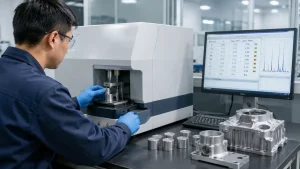
Certifications can only ensure a supplier’s process compliance, but the physical properties, internal defects, and heat treatment effects of aluminum castings must be judged through objective testing reports.
1. Material Testing Related Documents
- Chemical Composition Analysis Report (Spectrometric Analysis / PMI): Confirms whether the element contents of the aluminum alloy grade (such as A356, ADC12, etc.) meet standards.
- Performance Testing Report: Includes tensile strength, yield strength, elongation, and hardness test results.
- Metallographic Microstructure Inspection Report: Evaluates grain size, eutectic silicon morphology, and whether the microstructures are qualified.
2. Product Inspection Related Documents
- Dimension Inspection Report (CMM Coordinate Measuring Report): Verifies whether the critical dimensions and geometric tolerances of the casting fall within the drawing tolerance range.
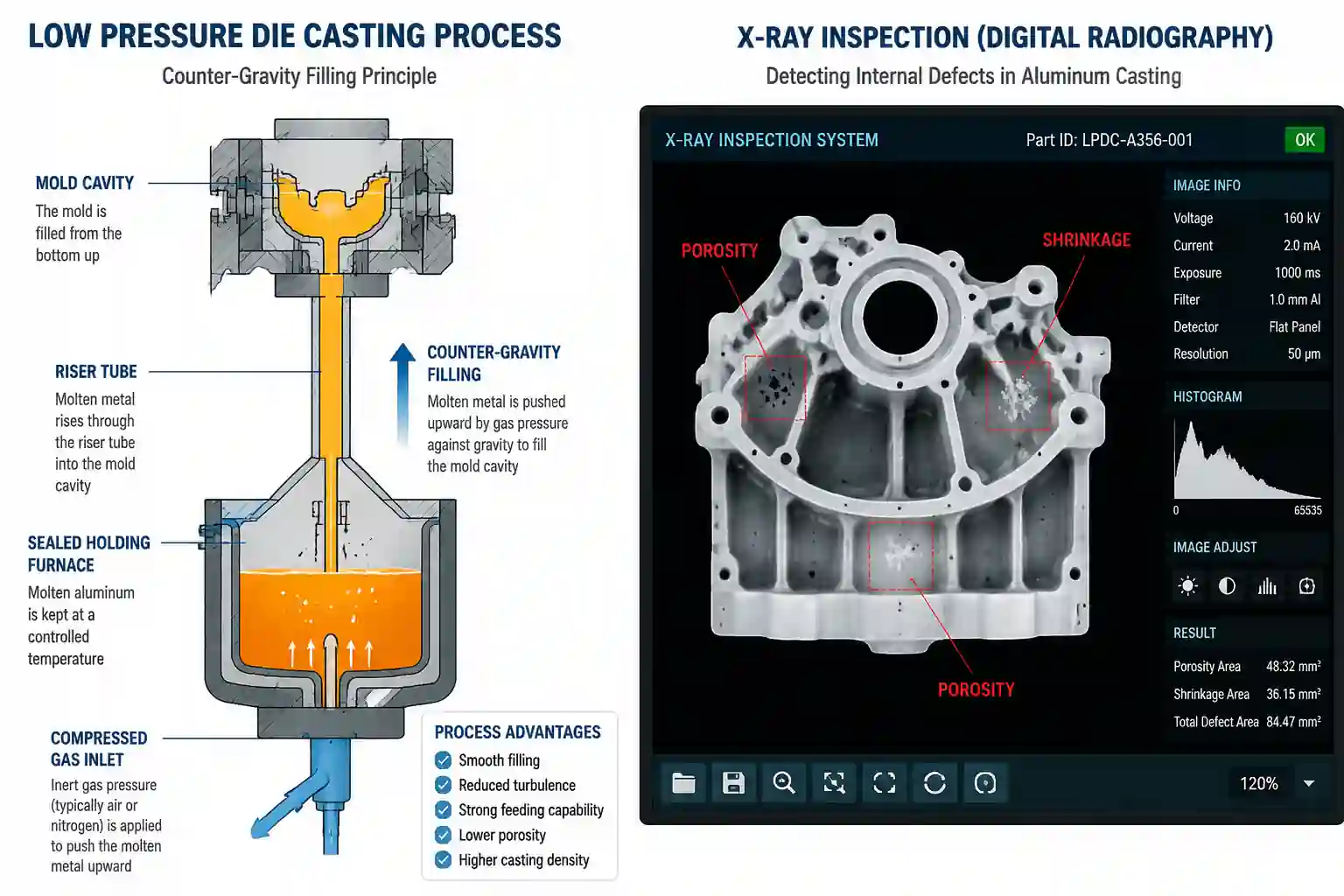
- Non-Destructive Testing (NDT) Report: Includes X-ray inspection, ultrasonic testing (UT), or penetrant testing (PT) to evaluate internal defects such as porosity, shrinkage, and cracks.
- Air Tightness / Pressure Test Report: Targeted at castings requiring sealing performance such as automotive engine blocks and valve bodies.
- Heat Treatment Process Records and Reports: Temperature curves and hardness compliance records for heat treatment processes like T6.
Recommended Third-Party Testing Agencies
To ensure the absolute impartiality of testing data, it is recommended to commission internationally recognized third-party testing and certification institutions to conduct inspections and issue certificates for suppliers:
- SGS (Société Générale de Surveillance)
- TÜV Rheinland / TÜV SÜD (TÜV Rheinland / TÜV SÜD Group)
- Bureau Veritas (BV)
- Intertek
Audit Checklist for Choosing Aluminum Casting Suppliers (Audit Checklist)
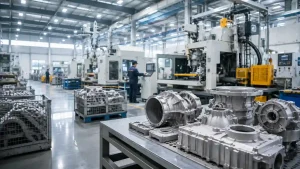
Before making the final decision to cooperate, please score across the following four major dimensions:
- Qualifications and System Audit: Whether the original certificates for ISO 9001, IATF 16949, etc., are genuine and valid, and whether there are annual review records.
- Equipment and Capacity Evaluation: Die casting machine / gravity casting machine tonnage, mold design and manufacturing capabilities (CAD/CAE simulation), number of CNC machining centers, and temperature-controlled melting equipment.
- Quality Control and Laboratory Capabilities: Whether necessary testing equipment is equipped, such as direct-reading spectrometers, Coordinate Measuring Machines (CMM), X-ray flaw detectors, and universal testing machines.
- Supply Chain and Environmental Management: Stability of raw and auxiliary material procurement channels, possession of EIA (Environmental Impact Assessment) qualifications, and capability to meet the EU’s new carbon footprint accounting requirements.
- Past Performance and Delivery Records: Whether they have mature European market export experience and historical product PPM (Parts Per Million defect rate) data.
Frequently Asked Questions (FAQ)
Q1: What are the basic certificates that must be included?
A: ISO 9001 (Quality Management System Certification) is the baseline foundation for all high-quality manufacturing enterprises. In addition, for the European market, ISO 14001 (Environmental Management System) and the capability to provide EU environmental new regulation and carbon data support are becoming increasingly vital.
Q2: Can certificates guarantee that products meet quality standards?
A: Not completely. Certificates only prove that the supplier possesses a compliant “production process and management system” and cannot directly substitute for the quality of single-batch products. Buyers must combine each batch’s material sheet, CMM dimension report, and third-party non-destructive testing report for comprehensive gatekeeping.
Q3: Can we cooperate with a foundry without certificates?
A: In principle, it is not recommended to choose suppliers without basic qualifications in the European high-end supply chain. If a supplier is deemed to have unique technology, they must pass strict First Article Inspection (FAI) and comprehensive deep audits by renowned third-party testing agencies as an alternative safeguard.