


Post-casting heat treatment is the controlled heating and cooling of a casting after it has solidified, done to change the microstructure and, with it, the mechanical properties. The same alloy can behave very differently before and after treatment: annealing softens, normalizing refines, quenching hardens, tempering restores toughness, and aging strengthens aluminum. For foundries and buyers alike, the treatment is where the casting is tuned to the drawing.
The choice of treatment depends on the material, the section thickness, the required hardness, and the cost target. This guide covers what heat treatment does, why castings need it, the main processes, how they change the structure, which metals respond, and where treated castings are used.
Post-casting heat treatment usually sits between shakeout and machining. The casting is rough-cleaned, treated in the furnace, then machined and inspected, so the drawing should state the required temper or hardness before tooling starts.
What Is Heat Treatment?
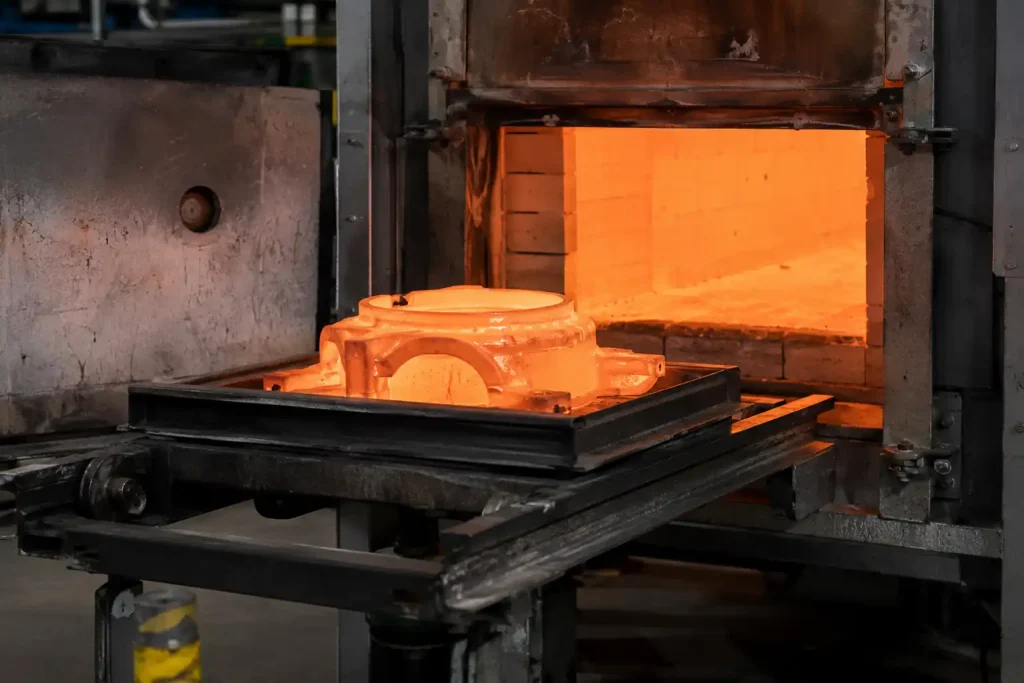
Heat treatment is a controlled sequence of heating, holding, and cooling applied to a metal to change its microstructure and therefore its properties. The heat treatment types share the same principle: the temperature profile decides what phases form, how fine the grains are, and how the metal responds to load, wear, and machining.
For castings, treatment happens after solidification, which is why it is called post-casting heat treatment. Castings that leave the mold with coarse or mixed structures are refined in the furnace before machining or service.
Why Is Heat Treatment Important?
- Strength and hardness. Quenching and aging raise yield strength, tensile strength, and surface hardness for load-bearing parts.
- Machinability. Annealing softens the casting so tools last longer and tolerances stay in control.
- Dimensional stability. Stress relieving and controlled cooling reduce residual stress and distortion that drive casting defects.
- Toughness. Tempering restores ductility and impact resistance lost during hardening.
- Wear life. Hardened surfaces resist abrasion and extend service life in demanding applications.
Types of Heat Treatment Processes
Each process uses a different temperature and cooling profile to produce a different structure.
Annealing
Annealing heats the casting, holds it at temperature, and cools it slowly to soften the metal and remove internal stress. It improves machinability and is common before machining for gray and ductile iron castings. For complex sections, annealing also reduces the risk of distortion.
Normalizing
Normalizing heats above the transformation range and cools in still air to refine the grain and produce a more uniform structure. It raises strength and consistency without the full hardness of quenching, and it is often chosen when sections of different thickness must behave alike.
Quenching and Tempering
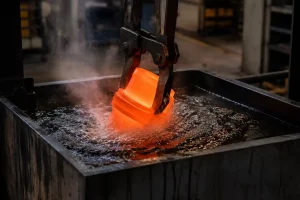
Quenching cools the casting rapidly to form hard microstructures, then tempering reheats it to a lower temperature to restore toughness. The pair delivers high strength with controlled ductility, and it is the standard route for gears, shafts, and wear parts.
Precipitation Hardening
Precipitation hardening dissolves alloying elements at high temperature and re-precipitates them as fine particles that block dislocation movement. Because the particles pin the structure, the treatment delivers high strength without heavy alloying, and it is the standard route for high-strength aluminum castings.
Aging
Aging is the low-temperature step that follows solution treatment, either naturally at room temperature or artificially in a furnace. Artificial aging runs at a controlled temperature for a set time; natural aging happens slowly at room temperature. Either way, the step develops the final strength of the T4, T5, and T6 tempers used for aluminum castings.
These processes work by changing what happens at the grain level. Slow cooling allows carbon to diffuse and form softer structures; rapid cooling traps it in harder phases; reheating lets some of that hardness give way to toughness. The same carbon content can produce soft, tough, or hard castings depending on the profile, and metal casting inspection methods such as hardness testing and metallography verify that the intended structure was achieved.
Applications of Heat-Treated Castings
Treated castings show up wherever strength, wear resistance, or consistency decides the service life, and the material decides the cycle: gray iron is usually stress-relieved or annealed before machining, steel castings go through normalize, quench, and temper, aluminum castings use solution treatment and aging, and stainless grades follow their own cycles. The value also depends on working with a casting supplier who controls the full heat treatment cycle.
- Automotive and machinery: gears, crankshafts, brake components, and housings that need strength and fatigue life.
- Pumps and valves: pressure-containing bodies, bonnets, and impellers where ductility and impact resistance matter.
- Wear components: grinding media, wear plates, and abrasion-resistant parts that benefit from hardened surfaces.
- Structural and energy parts: machine frames, wind and energy components, and heavy castings that need consistent mechanical properties.
Nodular Cast Iron – Cast Iron Casting Manufacturer
Send the part drawing, the service conditions, and the target hardness or temper to our engineers, and let them confirm the grade and the heat treatment cycle before tooling is committed. Getting the cycle right before production is cheaper than reworking a casting that missed the specification.