


Aluminum casting is a common method for manufacturing aluminum alloy parts, and it is often a process that must be determined during the design stage of a project. Although different methods all use molten aluminum to form parts, they are not equally suited to the same part structures, production volumes, or quality requirements. Choosing an unsuitable process may create additional difficulties in tooling, machining, or batch production. The following sections explain the main aluminum casting methods, their differences, and how to choose the right process for a specific project.
What Is Aluminum Casting?
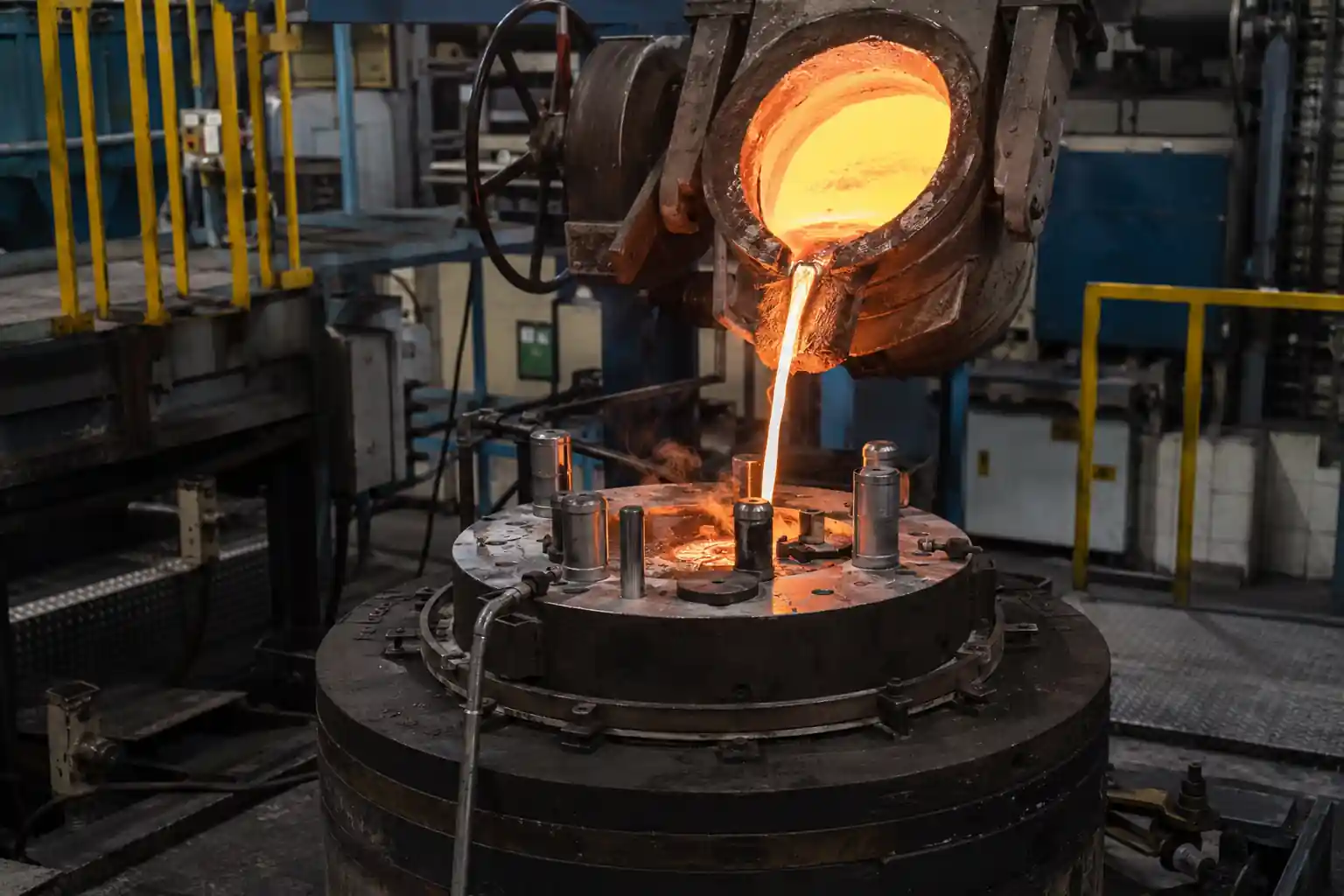
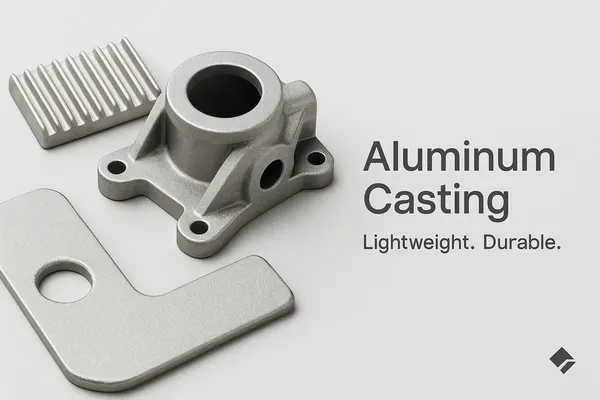
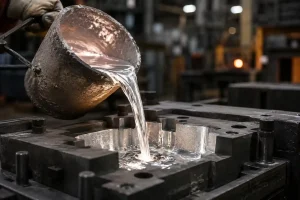
Aluminum casting is a manufacturing process in which aluminum or an aluminum alloy is heated until molten and then poured into a prepared mold. The molten metal gradually cools and solidifies inside the mold, forming the shape defined by the mold cavity. After the casting is removed, it usually undergoes cleaning, trimming, or other necessary finishing operations. This process can be used to produce aluminum alloy parts in a wide range of sizes and shapes for various industrial products.
Common Aluminum Casting Methods
Aluminum alloys can be formed using several casting methods, including sand casting, gravity die casting, low-pressure casting, high-pressure die casting, and investment casting. These processes differ not only in filling pressure, but also in mold type, production efficiency, achievable part geometry, and casting quality.
Sand Casting
Sand casting uses a disposable sand mold to form the part profile, while molten aluminum usually enters the cavity under gravity. Sand cores can be used to create internal passages or hollow sections.
This process offers good flexibility in part size and geometry. Pattern costs are relatively low, and design changes are easier to make, making it suitable for prototypes, low-volume production, and large castings. Its main limitation is that the sand surface is relatively rough, so dimensional repeatability and surface finish are generally lower than those achieved with metal-mold processes. Critical surfaces may also require additional machining allowance.
Gravity Die Casting
Gravity die casting uses a reusable metal mold, with molten aluminum flowing into the cavity under its own weight. In North American manufacturing, this process is also commonly known as permanent mold casting.
Because metal molds cool the casting more quickly, the resulting parts generally have better dimensional consistency, a smoother surface, and a finer structure than sand castings. The process provides a practical balance between tooling cost, casting quality, and production efficiency, making it suitable for stable medium-volume projects. However, because no additional filling pressure is applied, very thin walls, narrow sections, and long flow paths may increase the risk of incomplete filling.
Low-Pressure Casting
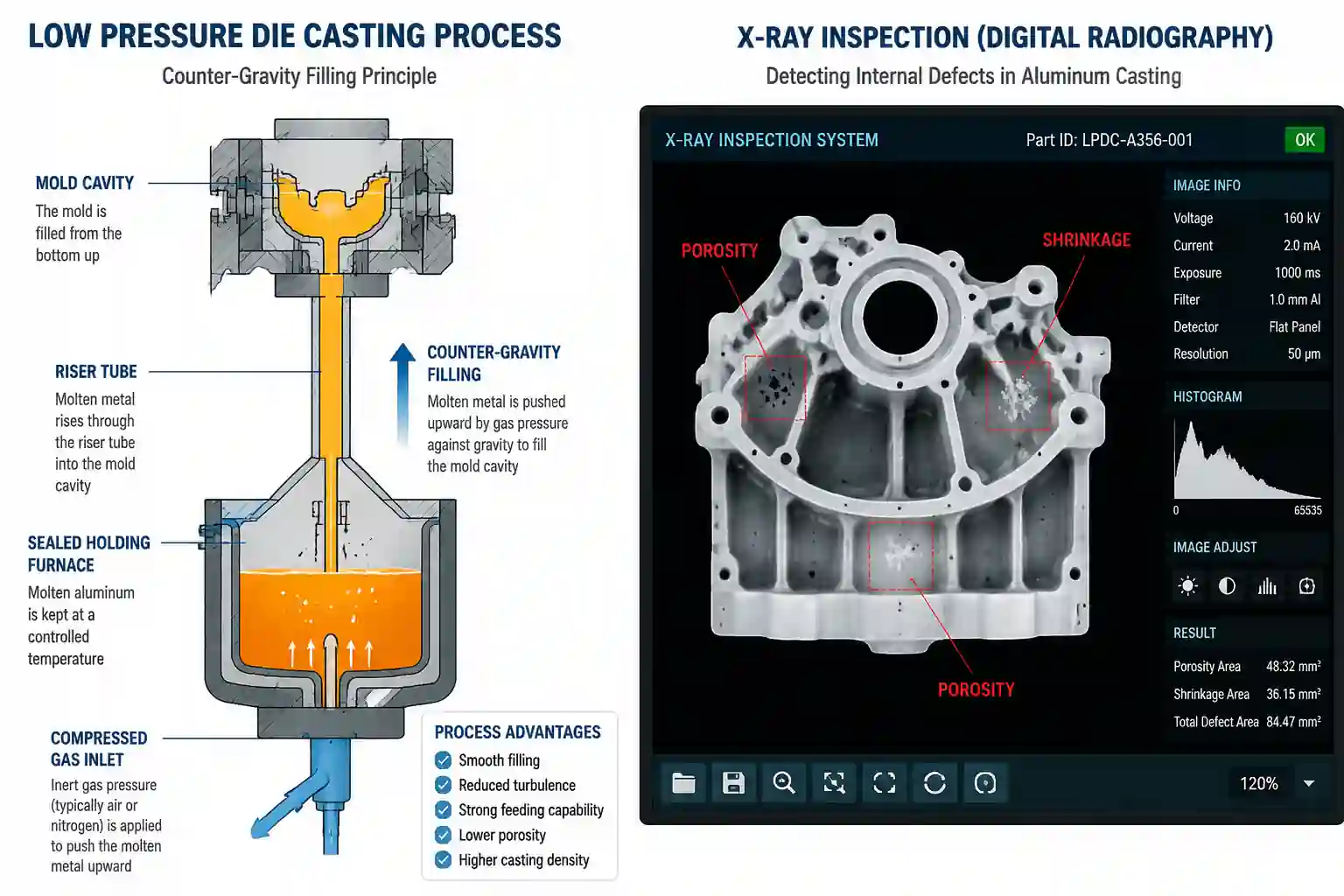
Low-pressure casting uses controlled gas pressure to force molten aluminum from a holding furnace upward into a metal mold. Pressure is then maintained while the casting solidifies.
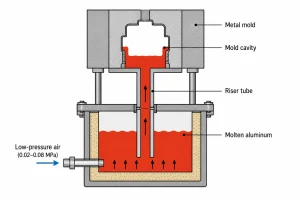
The relatively smooth filling process helps reduce metal turbulence and air entrapment, while continued pressure supports feeding and improves internal density. Compared with gravity casting, low-pressure casting is better suited to projects requiring higher levels of pressure tightness, heat-treatment capability, and internal quality. It does, however, require dedicated equipment and tighter process control, and its production cycle is usually slower than that of high-pressure die casting.
High-Pressure Die Casting
High-pressure die casting uses an injection plunger to force molten aluminum into a steel mold at high speed and pressure. In English manufacturing terminology, the term aluminum die casting usually refers to this process unless otherwise specified.
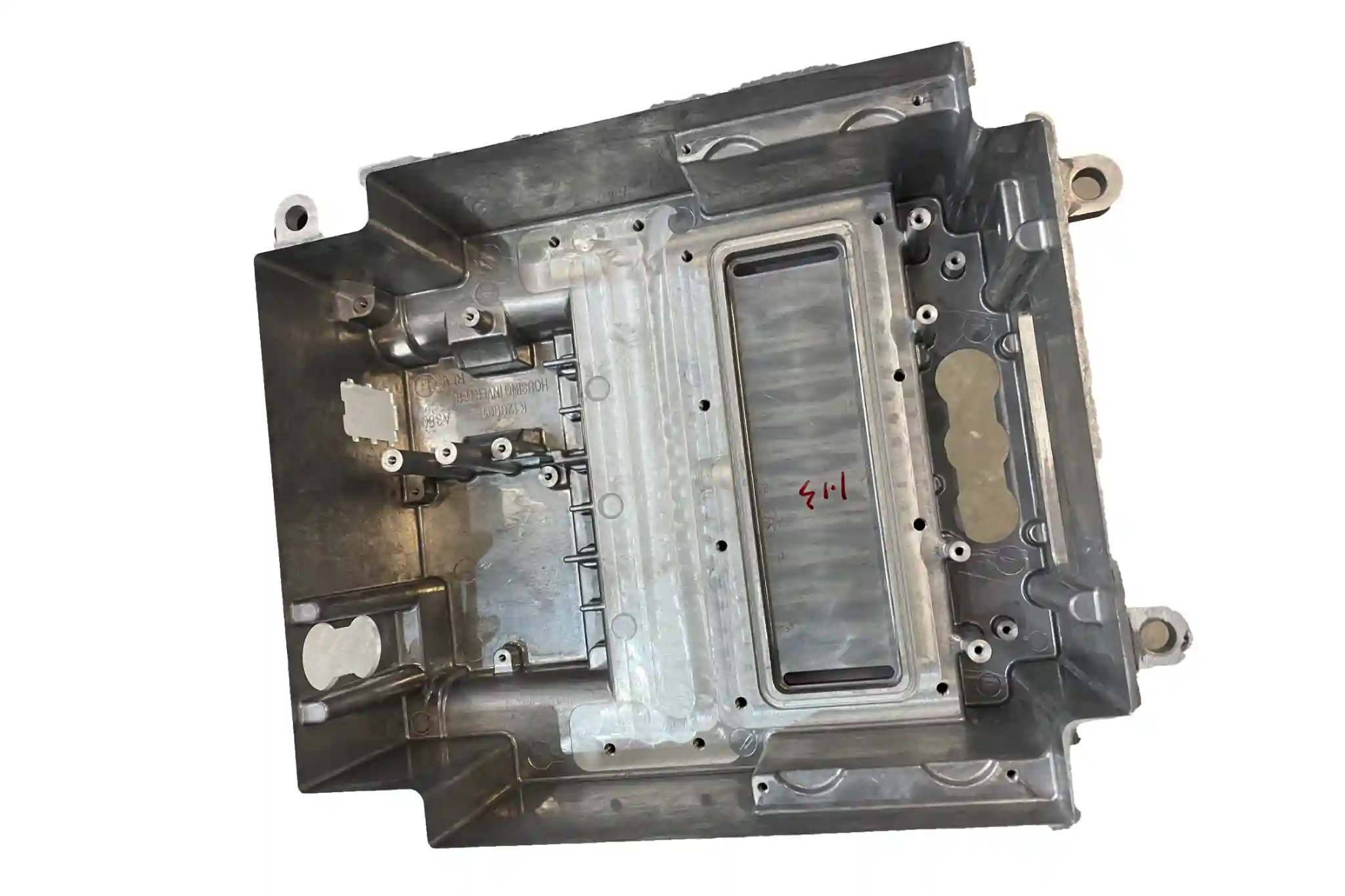
High-speed filling allows the process to produce thin walls, complex details, ribs, and bosses with high production efficiency and good dimensional repeatability. It is therefore well suited to stable, high-volume production. Its main limitations are the relatively high tooling investment and the risk of air entrapment during rapid filling. For parts requiring welding, solution heat treatment, or extensive machining, internal porosity should be evaluated in advance.
Investment Casting
Investment casting uses wax patterns to produce a ceramic shell. After the wax is removed, molten aluminum is poured into the resulting cavity to form the part.
This process is less restricted by conventional parting lines and can produce complex contours, fine features, and relatively good surface quality. It is suitable for small aluminum alloy parts with intricate geometry. However, wax-pattern production, shell building, drying, and firing add more process steps and extend the production cycle. As a result, unit costs are generally higher than those of sand casting, and the process is less suitable for very large parts or extremely high production volumes.
Advantages of Aluminum Casting
Aluminum casting offers several advantages, including lightweight construction, corrosion resistance, complex part formation, and recyclability. These properties make it suitable for automotive, aerospace, industrial equipment, electronics, and many other applications.
Lightweight
Aluminum has a much lower density than steel and cast iron. Using aluminum castings can reduce the overall weight of vehicles, machinery, and structural components while still providing sufficient mechanical performance for many industrial applications.
Corrosion Resistance
Aluminum naturally forms a protective oxide layer on its surface, giving aluminum castings good resistance to atmospheric corrosion. For outdoor, marine, or other corrosive environments, surface treatments such as anodizing or coating can provide additional protection.
Complex Structures
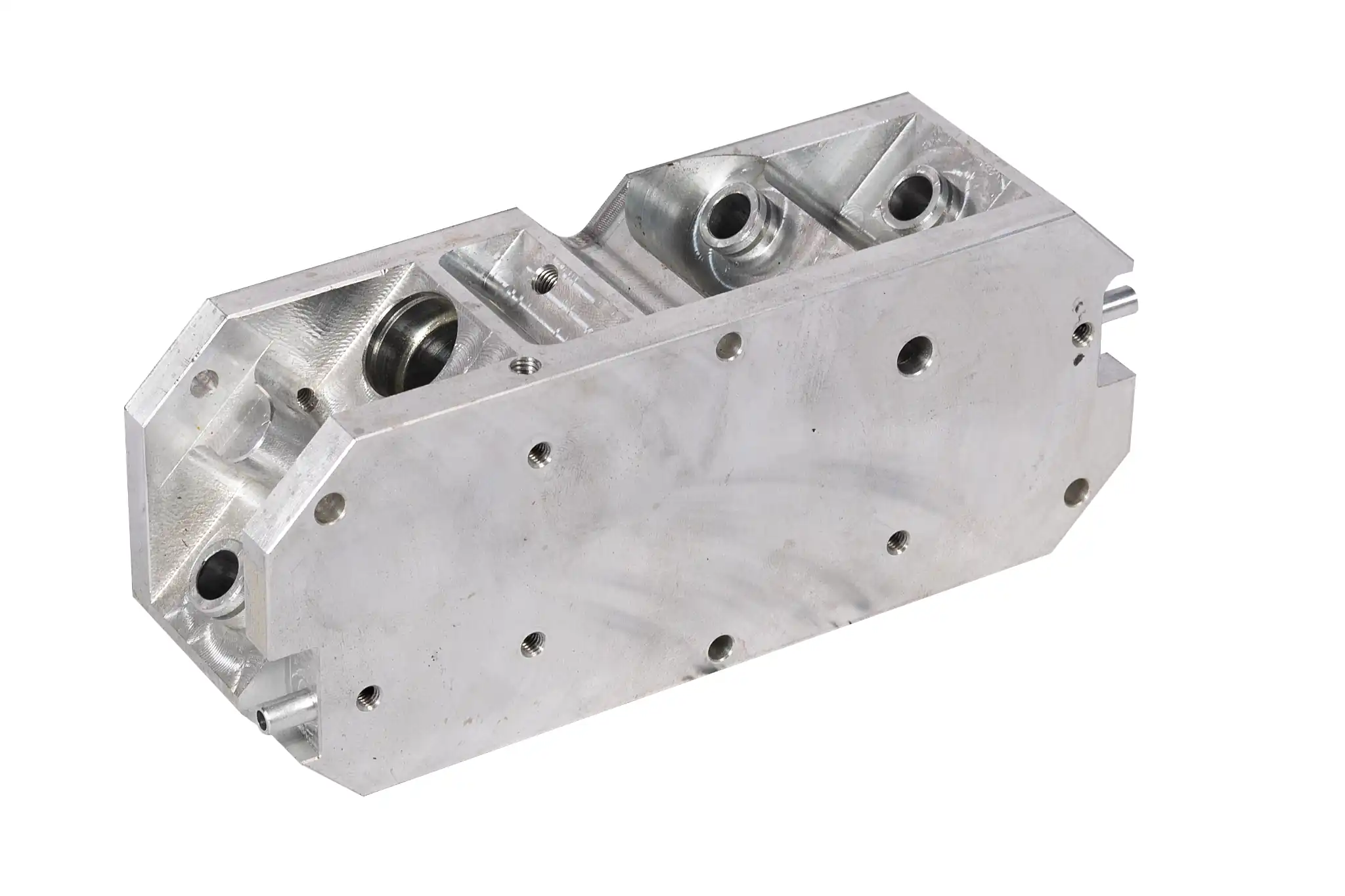
Aluminum casting can form ribs, bosses, mounting holes, internal cavities, and thin-wall features within a single component. This can reduce the number of separate parts, simplify assembly, and lower the need for additional machining.
Recyclability
Gates, risers, offcuts, and rejected castings generated during production can be sorted, remelted, and reused. With proper control of alloy composition and impurity levels, recycled aluminum can continue to be used in castings that meet the required specifications.
Applications of Aluminum Castings
Aluminum castings combine low weight, corrosion resistance, design flexibility, and reasonable production costs, making them suitable for many industrial sectors.
Automotive
Common applications include engine housings, transmission cases, suspension components, motor housings, wheels, and structural brackets. Aluminum alloys help reduce vehicle weight while providing sufficient strength for many automotive parts.
Aerospace
In the aerospace industry, aluminum castings are used for brackets, equipment housings, covers, supports, and other lightweight structural components. These parts often require low weight, dimensional stability, and consistent material properties.
Industrial Equipment
Typical applications include pump bodies, valve housings, gearbox cases, compressor components, robotic parts, and machine brackets. The casting process is usually selected according to the required strength, internal passages, production volume, and machining needs.
Electronics
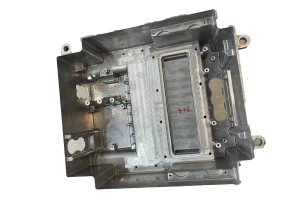
Aluminum castings are commonly used for heat sinks, LED housings, electrical enclosures, communication equipment cases, and power-system components. The good thermal conductivity of aluminum helps transfer heat away from operating equipment.
Infrastructure
Common applications include lighting housings, mounting arms, support brackets, electrical boxes, and outdoor equipment components. Aluminum castings are especially suitable for parts that require low weight and resistance to outdoor corrosion.
Aluminum casting can be used for both complex industrial components and repeat production at different volume levels.
How to Choose the Right Aluminum Casting Process
Different aluminum casting processes suit different part structures, production volumes, and quality requirements. The following factors can help narrow down the most suitable option.
Design Complexity
Sand casting is often more flexible for large parts, irregular shapes, or components with complex internal cavities. High-pressure die casting is better suited to thin walls, ribs, and small detailed features, while investment casting can be considered for smaller parts with intricate profiles.
Production Speed
In terms of production cycle, high-pressure die casting is generally the fastest, followed by gravity casting and low-pressure casting. Sand casting requires a new mold for each casting, while investment casting includes additional steps such as wax pattern production, shell building, and dewaxing, resulting in a longer overall lead time.
Production Volume
For low-volume production, sand casting is usually easier to justify because of its lower initial tooling cost. Gravity casting and low-pressure casting are more suitable for medium-volume production. When demand is high and stable, high-pressure die casting offers a stronger production-efficiency advantage.
Prototyping
Sand casting is often suitable for prototypes because order quantities are usually low and designs may still change. Pattern costs are relatively low, and modifications are easier to make without investing in complex metal tooling during the trial stage.
Strength and Surface Quality
Gravity casting and low-pressure casting generally provide a good balance of strength, dimensional stability, and surface quality, while low-pressure casting is more suitable when internal density is a priority. High-pressure die casting usually produces a smoother surface and better dimensional consistency. Sand castings have a rougher surface, so critical areas often require additional machining.
Conclusion
Aluminum casting is a highly adaptable manufacturing process that delivers lightweight, strong, and corrosion-resistant components across critical industries. By selecting the right casting method and alloy, manufacturers can meet demanding performance, design, and sustainability goals.
If you’re seeking reliable aluminum casting solutions for industrial or commercial applications, understanding the available processes and their benefits is key to making an informed choice.