
304 vs 316 Stainless Steel: Which Is the Perfect Choice for Your Project?

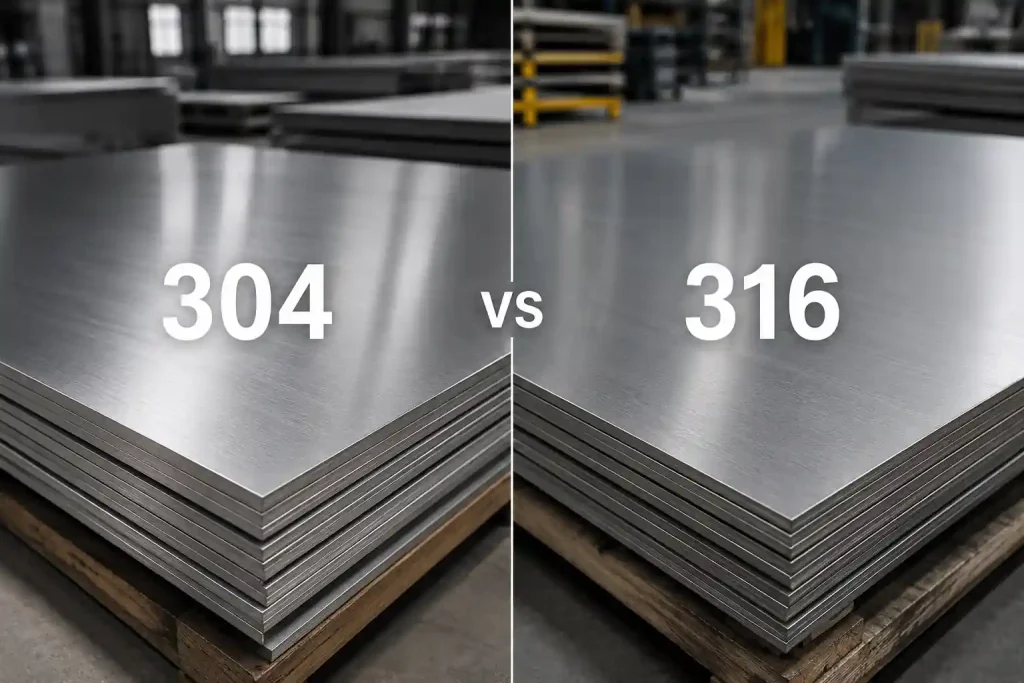
304 vs 316 stainless steel sheet comparison

Stainless steel is one of the most widely used metals in industrial manufacturing. It offers good corrosion resistance, heat resistance, and surface appearance, and is commonly used in food processing, chemical equipment, medical devices, automotive parts, and aerospace components. Although the name suggests that it does not rust, stainless steel can still develop rust, stains, pitting, or localized corrosion under certain conditions.

Stainless steel is available in many grades, and 304 and 316 are two of the most common stainless steel grades. Understanding their differences is useful for material selection, purchasing, machining, inspection, and long-term part performance.

This article introduces the chemical composition, key properties, applications, and selection factors of 304 and 316 stainless steel.

What Are 304 and 316 Stainless Steel?

304 and 316 are both austenitic stainless steels. They contain relatively high levels of chromium and nickel. Chromium helps form a stable passive film on the material surface, while nickel helps stabilize the austenitic structure, allowing the material to maintain good toughness, ductility, and weldability.

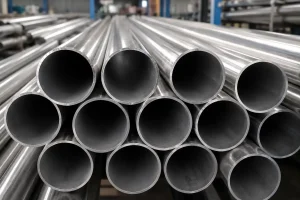
304 and 316 stainless steel pipes

As a result, both 304 and 316 stainless steel generally offer good corrosion resistance, toughness, and welding performance in many industrial applications.

304 Stainless Steel vs 316 Stainless Steel: 7  Differences

To choose the right stainless steel grade for your project, understanding their differences is vital. We’ve created the following table to provide a straightforward, side-by-side comparison of the key properties of 304 and 316 stainless steel. This table will be a powerful tool in helping you make an informed decision.

Comparison 304 Stainless Steel 316 Stainless Steel
Chemical Composition Usually contains about 18% chromium and 8% nickel Usually contains about 16% chromium, 10% nickel, and 2–3% molybdenum
Mechanical Strength Tensile strength about 515–620 MPa; yield strength about 205–310 MPa Tensile strength about 515–620 MPa; yield strength about 240–415 MPa
Corrosion Resistance Suitable for ordinary atmospheric, indoor equipment, and freshwater environments, but more sensitive to chlorides Because it contains molybdenum, it has better corrosion resistance in chloride, salt spray, marine, and some chemical environments
Heat Resistance Melting range about 1400–1450°C; common working temperature range about 20–870°C Melting range about 1375–1400°C; common working temperature range about 20–870°C
Weldability Good weldability; can use TIG, MIG, arc welding, spot welding, and laser welding Good weldability; can also use common stainless steel welding processes, with better corrosion resistance after welding
Machinability Better machinability, usually easier to control tool wear and machining efficiency Slightly more difficult to machine; stronger work hardening tendency may increase tool wear
Cost Usually lower cost and wider availability Usually higher cost, mainly affected by molybdenum, nickel content, and market prices

Chemical Composition

The main elements in both 304 and 316 stainless steel are iron, chromium, and nickel. 304 usually contains about 18–20% chromium and 8–10.5% nickel, so it is also commonly known as 18/8 stainless steel.

316 has a similar base composition to 304, but it additionally contains about 2–3% molybdenum, and its nickel content is usually slightly higher. In other words, molybdenum is the key compositional difference between 304 and 316.

These compositional differences also lead to differences in corrosion resistance, cost, and application environments between 304 and 316.

Mechanical Properties

The tensile strength of 304 and 316 stainless steel is similar, usually around 515–620 MPa. This means the difference between the two grades is not significant for general tensile strength requirements.

The yield strength of 316 is usually higher than that of 304. The yield strength of 304 is generally about 205–310 MPa, while 316 is generally about 240–415 MPa. Simply put, 316 is usually less likely to deform under load.

In terms of hardness, both grades are usually around 70–90 HRB, with no major difference.

Corrosion Resistance

Both 304 and 316 stainless steel have good corrosion resistance because chromium helps form a passive film on the surface. 304 performs well in ordinary atmospheric conditions, indoor equipment, and freshwater environments, but it is more vulnerable to pitting or localized corrosion in seawater, salt spray, chloride-containing cleaners, and some chemical media.

316 contains 2–3% molybdenum, which improves resistance to chloride-related corrosion. For this reason, 316 is usually more suitable than 304 for industrial parts used in marine, chemical, high-humidity, or other corrosion-sensitive environments.

Heat Resistance

Both 304 and 316 stainless steel have good heat resistance. The melting point of 304 stainless steel is usually slightly higher than that of 316. The melting range of 304 is about 1400–1450°C (2552–2642°F), while the melting range of 316 is about 1375–1400°C (2507–2552°F).

In terms of working temperature, 304 is commonly used at about 20–870°C (68–1598°F) and can withstand around 925°C (1697°F) for short periods. The working temperature range of 316 is close to that of 304, usually also around 20–870°C (68–1598°F).

It should be noted that continuous use of 304 at about 425–860°C (797–1580°F) may increase the risk of corrosion. In comparison, because 316 contains molybdenum, it usually has better corrosion resistance than 304 when high temperature is combined with chlorides, chemical media, or humid environments.

Weldability

304 and 316 stainless steel both have good weldability and can usually be welded using common stainless steel welding processes, such as TIG welding, MIG welding, arc welding, spot welding, and laser welding.

The weldability of stainless steel is closely related to its carbon content. During welding, higher carbon content may increase the corrosion risk in the heat-affected zone. Therefore, for parts with higher welding requirements or parts that need to maintain corrosion resistance after welding, low-carbon versions such as 304L or 316L are often considered.

Cost

304 stainless steel is usually less expensive than 316. The higher cost of 316 is mainly because it contains about 2–3% molybdenum, and its nickel content is usually slightly higher than that of 304. Both molybdenum and nickel are relatively costly alloying elements, so they increase the material price of 316.

The actual price of 304 and 316 can also be affected by many factors, including material form, plate or bar specifications, purchase quantity, surface condition, delivery time, and fluctuations in nickel and molybdenum prices. Therefore, price differences may vary between different suppliers and different batches.

Applications

304 and 316 stainless steel are both widely used in industrial equipment and structural parts. 304 is more common for general-purpose parts in ordinary environments, while 316 is more often used in environments that require higher corrosion resistance.

Applications of 304 Stainless Steel

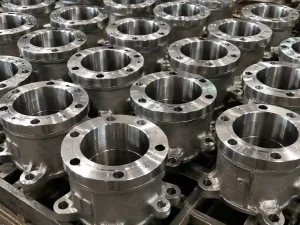
Machined stainless steel flange castings

Common applications include:

  • Food processing equipment: equipment housings, covers, brackets, mixer parts, conveyor components, and general pump parts

  • General industrial equipment: machine frames, enclosures, supports, flanges, connectors, and machined structural parts

  • Architectural decoration: indoor railings, panels, brackets, decorative parts, and fasteners

  • Freshwater fluid equipment: pipe connectors, valve components, general pump bodies, and fittings

  • Automotive machinery equipment: brackets, covers, fasteners, and structural parts used in non-severe corrosive environments

Applications of 316 Stainless Steel

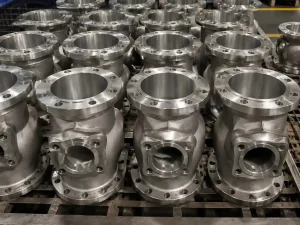
Machined stainless steel valve castings

Common applications include:

  • Marine equipment: pump housings, impellers, valve bodies, flanges, fittings, and marine hardware

  • Chemical equipment: valve bodies, pump bodies, pipe connectors, reactor components, and corrosion-resistant housings

  • Food equipment: liquid-contact housings, fittings, pump parts, and parts used in aggressive cleaning environments

  • Medical equipment: surgical instrument components, equipment parts, and corrosion-resistant precision components

  • Water treatment equipment: valves, pump parts, filtration equipment components, and flow passage parts

Frequently Asked Questions (FAQ)

How Can You Tell the Difference Between 304 and 316 Stainless Steel?

304 and 316 look very similar, so they usually cannot be distinguished by color, surface finish, or touch alone. The key difference is that 316 contains about 2–3% molybdenum, while 304 usually does not contain molybdenum.

Common identification methods include:

1. Use a molybdenum test solution
This is a simple field screening method. Apply the test solution to a clean metal surface. If the reaction indicates the presence of molybdenum, the material is more likely to be 316.

2. Check the material certificate
In industrial purchasing and incoming inspection, buyers usually check the MTR / material certificate to verify the material grade, heat number, and chemical composition.

3. Use PMI or XRF testing
This method can directly check the alloy composition and confirm whether the material contains molybdenum. It is more suitable for critical parts and batch inspection.

4. Laboratory chemical analysis
If there is a quality dispute or a high-requirement project, samples can be sent for chemical composition analysis. The result is more formal.

Do 304 and 316 Stainless Steel Rust?

304 and 316 are not completely rust-proof. They resist corrosion through a passive film on the surface. 304 performs well in ordinary environments, while 316 contains 2–3% molybdenum, which helps reduce pitting corrosion in chloride environments such as marine exposure, salt spray, and aggressive cleaning agents.

Because of this, 316 usually has better corrosion resistance than 304, but it can still rust or pit if the environment is severe or the surface condition is poor.

Are 304 and 316 Stainless Steel Magnetic?

Standard austenitic 304 and 316 stainless steels are usually non-magnetic or only very weakly magnetic in the annealed condition.

In actual industrial parts, however, cold working processes such as forging, stamping, drilling, or welding may change part of the austenitic structure into martensite, which can create noticeable magnetism. This is a normal physical change caused by processing and does not necessarily mean the material is unqualified.

Conclusion

The choice between 304 and 316 depends on the needs of the application, and there are also many factors to consider. Although 316 is more corrosion-resistant than 304, its cost is higher. If you are considering which stainless steel to choose, this article may be helpful to you. If you have outsourcing needs, MinHe has rich experience and can help you choose the right material.

MinHe is a custom metal parts manufacturer providing metal casting, CNC machining, and related post-processing services. If your project involves stainless steel castings, machined parts, pump and valve components, housings, or flanges, we can help evaluate the right material and manufacturing solution based on your drawings and application environment.

Articles with Related Tags

Drop us a line