
Copper is a common industrial metal used in electrical parts, heat-transfer components, copper alloy castings, and machined parts. For engineers and buyers, copper density is not just a material property. It also affects part weight, raw material cost, blank size, and shipping weight.
This guide covers the density of pure copper, common copper alloys, and standard copper grades. It also compares copper with aluminum, steel, brass, and bronze, and explains how to calculate copper part weight using volume and density.
What Is the Density of Copper?
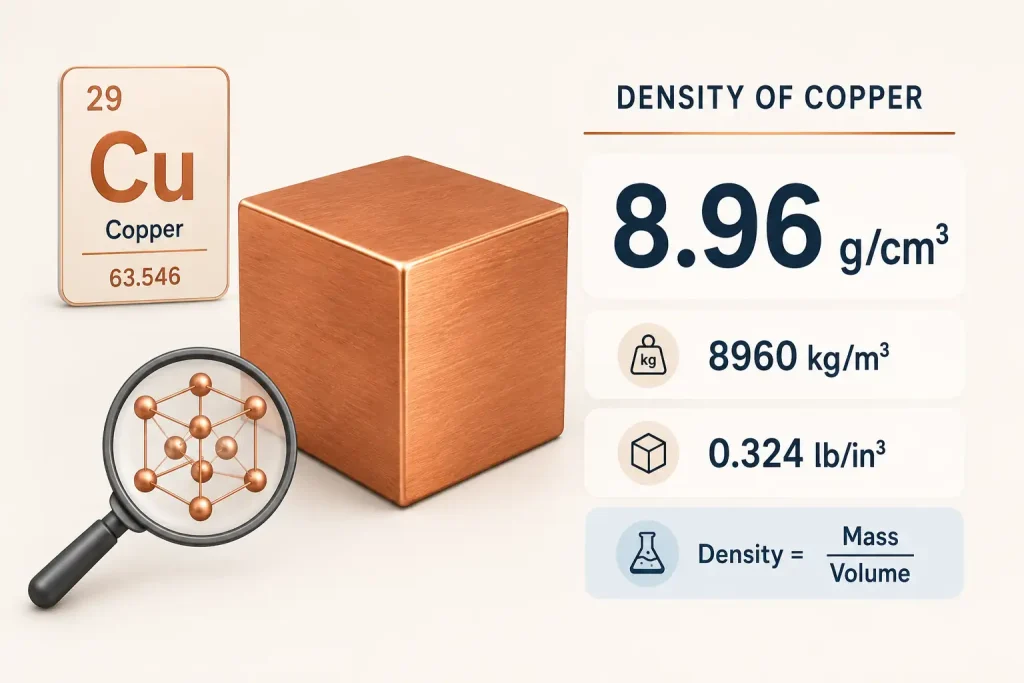
Pure copper has a density of about 8.96 g/cm³あるいは 8960 kg/m³. In imperial units, copper density is about 0.324 lb/in³あるいは 559 lb/ft³.
Density means how much mass a material has in a given volume. In engineering use, copper density is commonly used to estimate part weight, material cost, blank size, and shipping weight.
Density of Different Copper Alloys
Copper alloy density is not a fixed value because different copper alloys contain different amounts of zinc, tin, aluminum, nickel, or other elements. These elements are usually added to improve strength, corrosion resistance, wear resistance, or machinability, but they also change the overall density of the material.
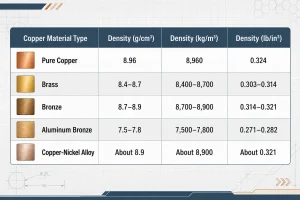
The table below lists typical density values for common copper material types, including pure copper, brass, bronze, aluminum bronze, and copper-nickel alloy. These values can be used for material selection and weight estimation.

純銅
Pure copper has a typical density of about 8.96 g/cm³ and is often used as the baseline for comparing other copper alloys. Because of its good electrical and thermal conductivity, pure copper is commonly used in electrical connectors, conductive parts, and heat-transfer components.
真鍮
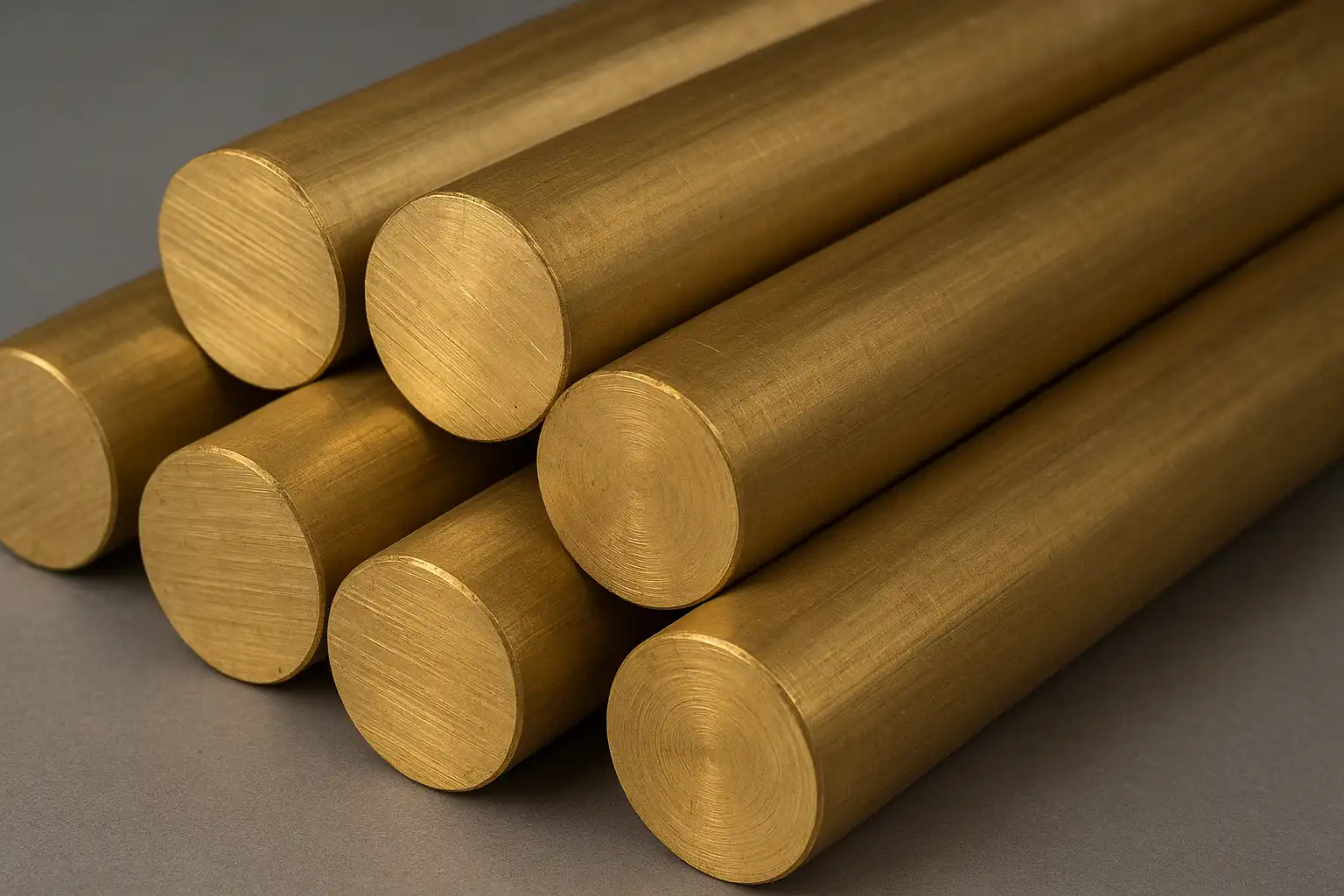
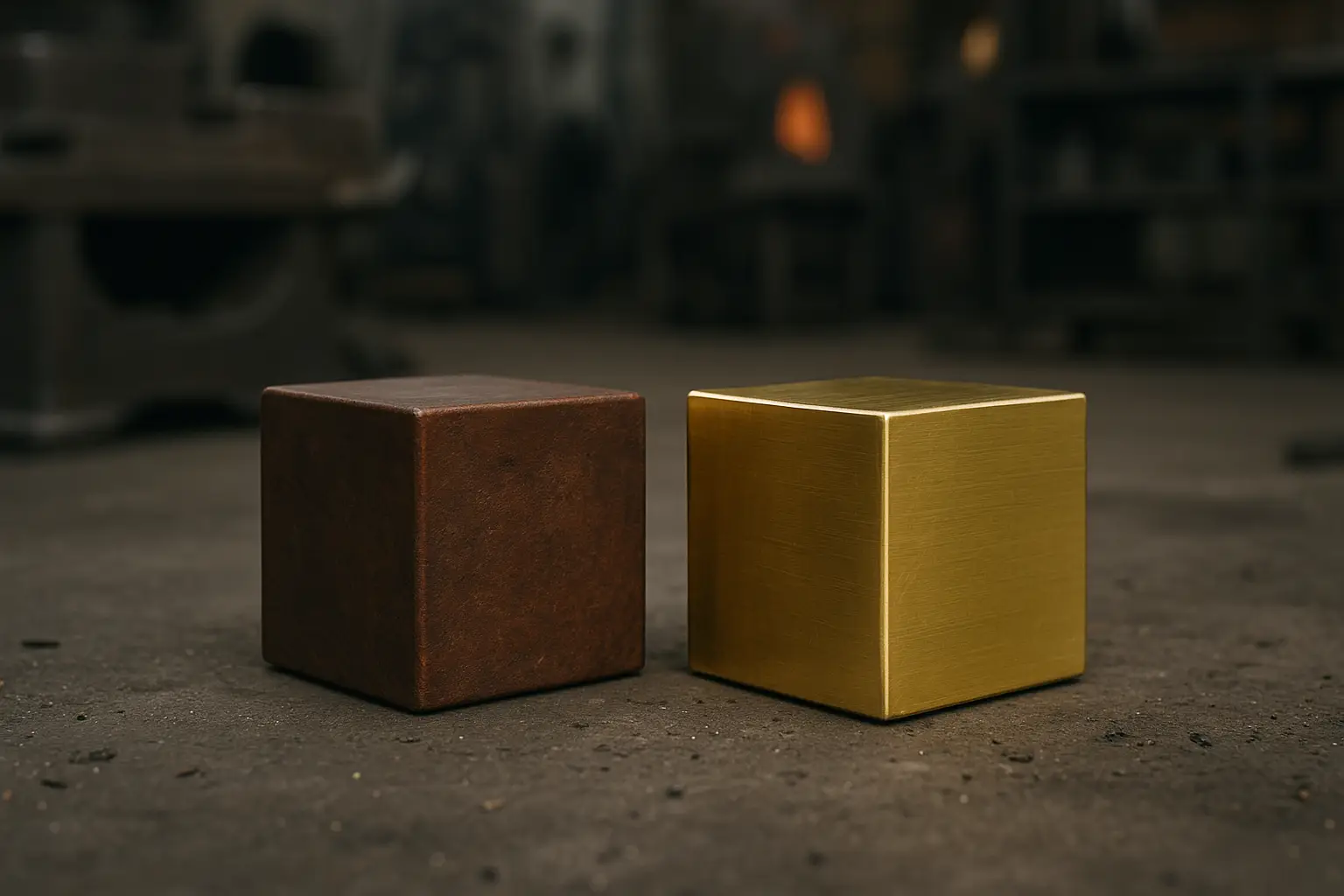
Brass is a copper-zinc alloy with a typical density of about 8.4–8.7 g/cm³. Since zinc is less dense than copper, most brasses are slightly lighter than pure copper. Brass also offers good machinability, making it common for valves, fittings, decorative parts, and precision machined components.
ブロンズ
Bronze usually has a density of about 8.7–8.9 g/cm³, depending on tin content and other alloying elements. Its density is close to pure copper, but its strength, wear resistance, and casting performance often make it more suitable for bushings, bearings, and industrial castings.
アルミニウム・ブロンズ
Aluminum bronze usually has a density of about 7.5–7.8 g/cm³, which is noticeably lower than pure copper and common bronze. This lower density is mainly related to the addition of aluminum. Aluminum bronze also provides high strength, good corrosion resistance, and strong wear performance, so it is often used for marine components, pump and valve parts, and wear-resistant castings.
Copper-Nickel Alloy
Copper-nickel alloys usually have a density of about 8.9 g/cm³, close to pure copper. Because nickel improves stability in seawater and corrosive environments, copper-nickel alloys are commonly used for marine parts, heat exchangers, and corrosion-resistant components
Density of Common Copper Grades
Different copper grades have slightly different densities because their chemical compositions are not exactly the same. When estimating part weight, material cost, or blank size, it is better to use the density of the specific grade if the grade is already known.
The table below shows typical density references for common copper and copper alloy grades. Exact values may vary slightly by standard, composition range, and supplier data.
| Copper Grade | Material Type | 密度 (g/cm³) | Density (kg/m³) | Density (lb/in³) |
|---|---|---|---|---|
| C11000 | Electrolytic Tough Pitch Copper | 8.89–8.96 | 8890–8960 | 0.321–0.324 |
| C10100 | Oxygen-Free Copper | 8.94 | 8940 | 0.323 |
| C26000 | Cartridge Brass | 8.53 | 8530 | 0.308 |
| C36000 | Free-Cutting Brass | 8.50 | 8500 | 0.307 |
| C93200 | Bearing Bronze | 8.83 | 8830 | 0.319 |
| C95400 | アルミニウム・ブロンズ | 7.64 | 7640 | 0.276 |
| C70600 | 90-10 Copper Nickel | 8.94 | 8940 | 0.323 |
C11000 and C10100 have densities close to pure copper. Brass grades such as C26000 and C36000 are usually slightly lighter, while C95400 aluminum bronze has a much lower density because of its higher aluminum content.
Copper Density Compared with Other Materials
Comparing copper with other common industrial metals can help designers understand how material choices affect part weight, cost, and structural design.
| 素材 | 密度 (g/cm³) | Density (kg/m³) | Density (lb/in³) | Compared with Copper |
|---|---|---|---|---|
| アルミニウム | 2.70 | 2700 | 0.098 | Copper is about 3.3 times heavier |
| 鉄 | 7.87 | 7870 | 0.284 | Slightly lighter than copper |
| 炭素鋼 | 7.85 | 7850 | 0.284 | Slightly lighter than copper |
| ステンレス鋼 | 7.9–8.0 | 7900–8000 | 0.285–0.289 | Slightly lighter than copper |
| 真鍮 | 8.4–8.7 | 8400–8700 | 0.303–0.314 | Slightly lighter than pure copper |
| ブロンズ | 8.7–8.9 | 8700–8900 | 0.314–0.321 | Close to copper |
| 銅 | 8.96 | 8960 | 0.324 | - |
Copper is much heavier than aluminum, making aluminum a better choice when lightweight design is a priority. However, copper is only slightly heavier than iron, carbon steel, and common stainless steel. Copper and its alloys are chosen for applications where electrical conductivity, thermal conductivity, corrosion resistance, or wear resistance are important.
How to Calculate the Weight of a Copper Part
The weight of a copper part can be calculated by multiplying its volume by the density of the selected copper material:
Weight = Volume × Density
For pure copper, the commonly used density is 8.96 g/cm³. Before calculation, make sure the volume unit matches the density unit. If the volume is measured in cm³, the result will be in grams when using g/cm³.

Method 1: Calculate Weight from Known Volume
If the part volume is already known, the weight can be calculated directly.
For example, if a copper part has a volume of 100 cm³ and pure copper density is 8.96 g/cm³:
100 cm³ × 8.96 g/cm³ = 896 g
So the theoretical weight of the part is 896 gあるいは 0.896 kg.
This method is useful for simple engineering checks, early design estimation, and CAD-based volume calculation.
Method 2: Estimate Weight from Copper Stock Dimensions
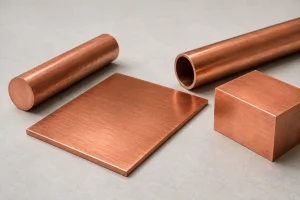
For copper bars, plates, sheets, and tubes, weight can also be estimated from external dimensions. The following formulas use mm as the dimension unit and are based on a copper density of 8.96 g/cm³:
- Copper round bar:
Weight (kg) = 0.00000703 × Diameter² × Length - Copper plate or sheet:
Weight (kg) = 0.00000896 × Thickness × Width × Length - Copper tube:
Weight (kg) = 0.0000281 × Wall Thickness × (Outer Diameter − Wall Thickness) × Length
These formulas are useful for raw material estimation, purchasing, warehouse planning, and early quotation. For brass, bronze, aluminum bronze, or copper-nickel alloys, the coefficient should be adjusted according to the actual alloy density.
For complex copper parts, the volume can usually be taken directly from a CAD model and then multiplied by the density of the selected copper or copper alloy. In actual production, machining allowance, cutting loss, gates, risers, and other process losses should also be considered. For irregular physical samples, the displacement method can also be used to estimate volume, but for engineering design and quotation, CAD volume and material density data are usually more practical.
What is the Atomic Mass of Copper?
In metallurgy and materials science, atomic mass is the fundamental property that dictates a metal’s behavior. The standard atomic weight of copper is 63.546 u (commonly rounded to 63.55 for engineering calculations).
In nature, copper consists of two stable isotopes, and its atomic mass is the weighted average of their abundance:
- Copper-63 (~69.17%)
- Copper-65 (~30.83%)
This atomic mass, combined with copper’s Face-Centered Cubic (FCC) crystal structure, results in its high density of approximately 8.96 g/cm³ and exceptional conductivity. During alloying, the difference in atomic mass directly affects the final weight. For instance, replacing copper atoms with lighter aluminum atoms (atomic mass ~26.98) significantly reduces density, creating high-strength yet lightweight aluminum bronze.
Factors That Affect Copper Density
While density is often treated as a constant, several factors can cause minor variations in industrial settings:
- Alloying elements: The addition of zinc, tin, aluminum, nickel, and other elements change copper alloy density.
- Material purity: Pure copper, oxygen-free copper, and impurity-containing copper may have slight density differences.
- Temperature: As temperature increases, copper expands and density decreases slightly.
- Porosity and casting defects: Pores, shrinkage, or looseness can make the measured density lower than theoretical density.
- Material condition: Processing and heat treatment usually affect density less than composition, but may still matter in precise calculations.
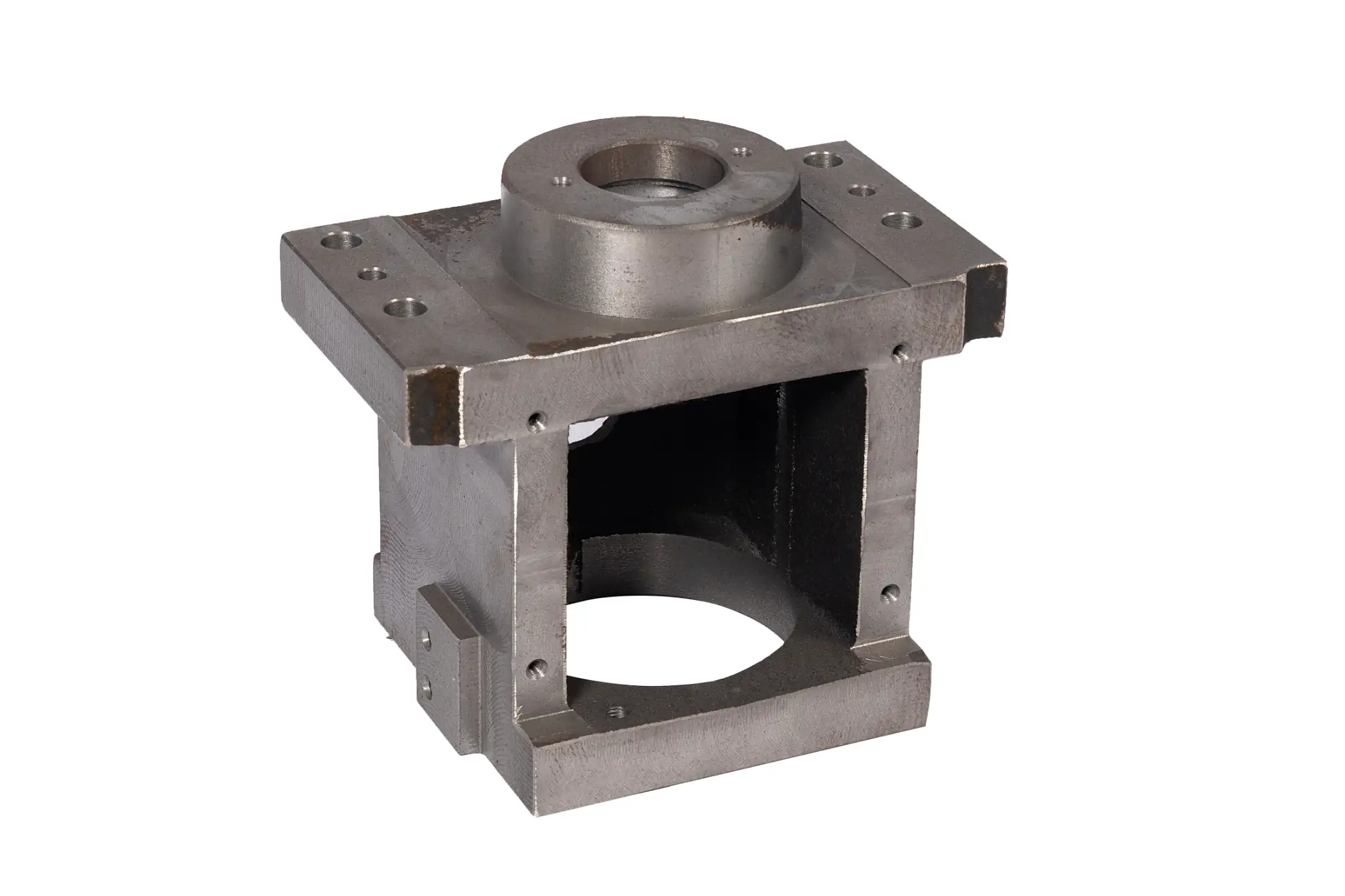
For cast copper alloy parts, theoretical density should be considered together with casting quality and internal soundness.
Industrial Applications of Copper Density
In industrial engineering, the high density of copper is often a calculated trade-off. Its mass is synonymous with high atomic packing, which delivers the superior conductivity and durability required in critical sectors:
- Power & Electrical Infrastructure: Copper’s density allows for the highest electrical conductivity per volume. This enables the design of compact transformers and motors that handle high current loads without the excessive bulk required by lighter but less conductive materials.
- Thermal Management & Electronics: Because copper is denser than aluminum, it possesses a higher thermal mass. In heat sinks and EV cold plates, this density allows for superior heat absorption and dissipation within a smaller physical footprint.
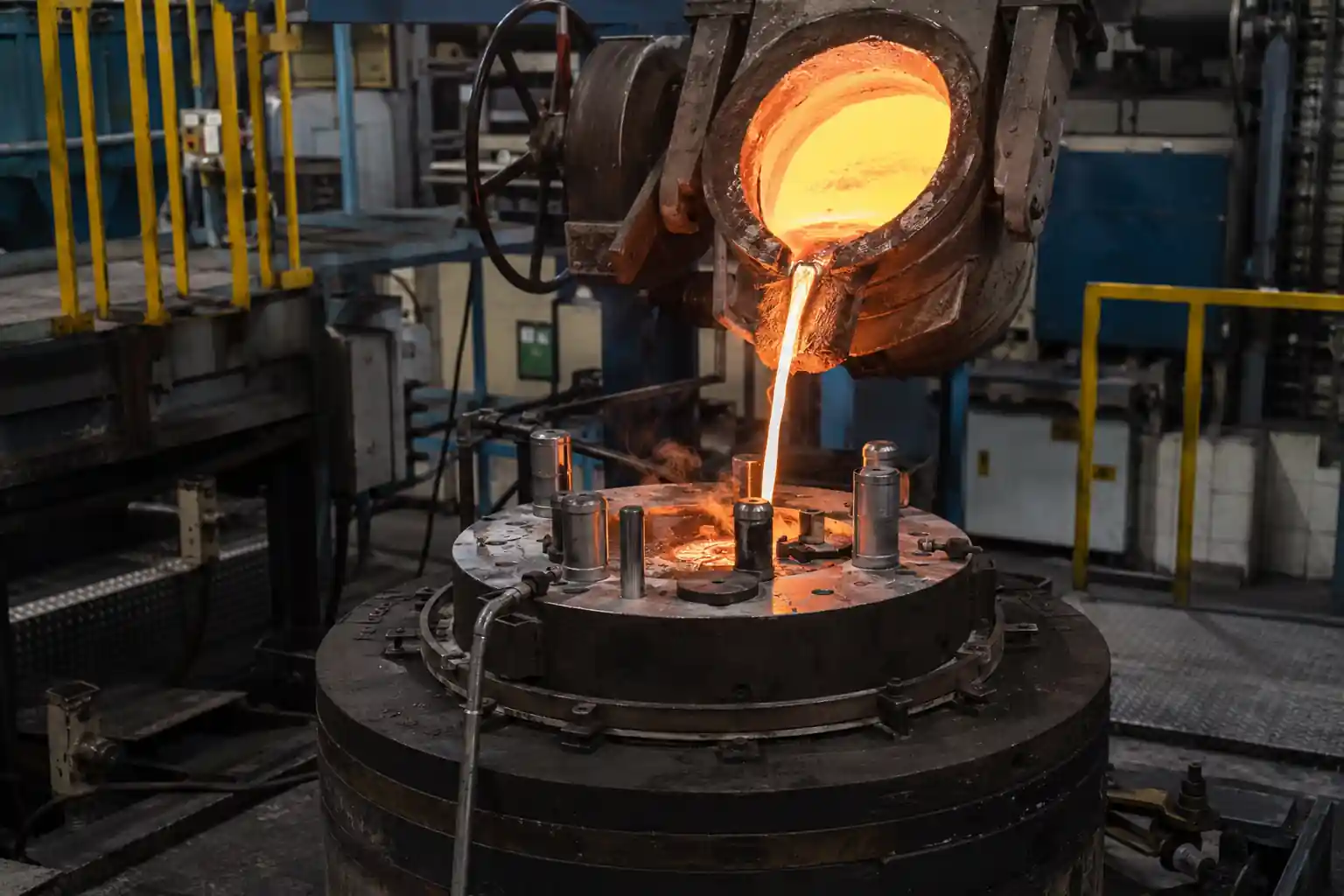
- Marine & Fluid Control: The density of copper alloys (such as Aluminum Bronze) is a key indicator of their structural integrity. It is the material of choice for high-pressure valves and pump impellers that must resist saltwater corrosion and mechanical wear for decades.
- 重機: The substantial mass of copper-based bushings and bearings provides the essential vibration dampening and load-bearing stability required in heavy industrial equipment.
While materials like aluminum offer a weight advantage, copper is selected when performance density is the priority. In applications ranging from subsea power cables to high-performance microprocessors, copper’s density is the physical foundation for its unmatched electrical, thermal, and anti-corrosive reliability.
よくあるご質問
Why does copper have a high density?
Copper has a high density mainly because copper atoms have a relatively high atomic mass and a closely packed crystal structure. Compared with lightweight metals such as aluminum, copper contains more mass in the same volume, so copper parts are usually much heavier.
What is the purity of pure copper?
In industrial use, pure copper usually refers to copper materials with very high copper content, such as electrolytic tough pitch copper and oxygen-free copper. Many pure copper grades contain 99.9 % copper or higher, but the exact purity depends on the material grade and standard. For example, C11000 and C10100 are both high-purity copper grades, but their oxygen content and typical applications are not exactly the same.
How does copper alloy density affect casting cost?
Copper alloy density affects material consumption. A higher-density alloy requires more metal to fill the same mold volume. For copper alloy castings, engineers usually compare blank weight そして net finished weight to estimate material cost more accurately.
結論
The average density of copper, approximately 8.96 g/cm³, serves as a core benchmark in engineering calculations. While significantly heavier than aluminum and slightly denser than steel, copper alloy density fluctuates depending on specific compositions and grades.
In practice, precise density data is the foundation for cost control, blank design, and logistics planning. Despite its weight, copper and its alloys remain indispensable in modern industry due to their superior electrical, thermal, and corrosion-resistant properties. Understanding the density variations across different grades empowers engineers to achieve the optimal balance between material performance and structural weight optimization.