


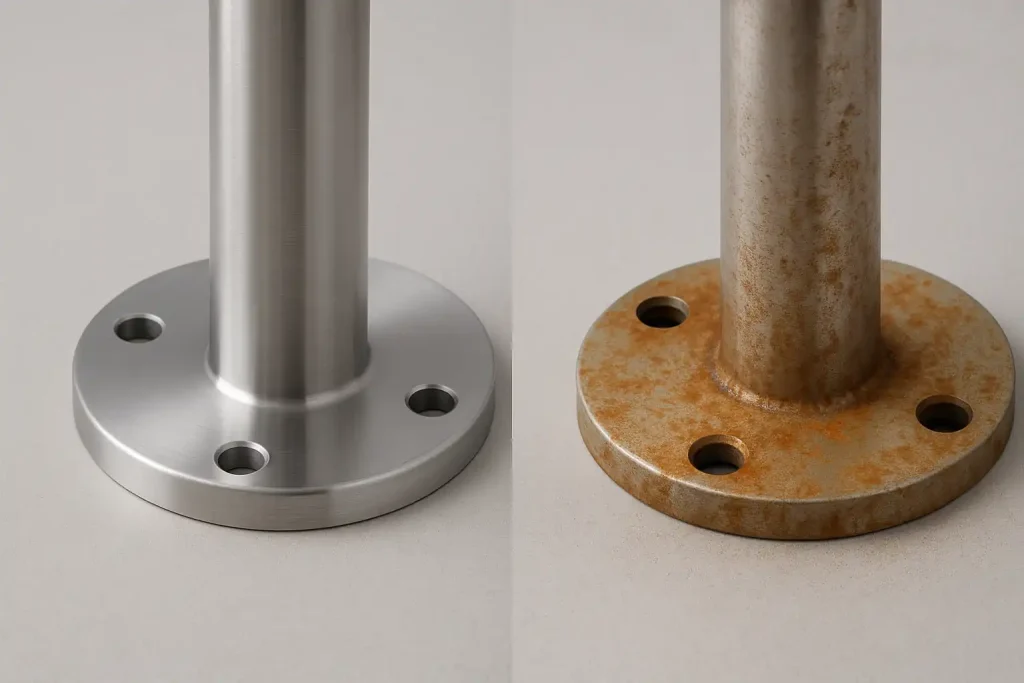
Stainless steel is widely considered a corrosion-resistant material, but “corrosion-resistant” does not mean “corrosion-proof.” In casting, machining, and industrial applications, stainless steel components may still develop rust when exposed to certain environments or when the passive film is damaged. Understanding why stainless steel resists corrosion, when it can rust, and how to prevent corrosion is key to selecting the right grades and ensuring long-term performance of stainless steel castings and precision components.
Does Stainless Steel Rust?
Stainless steel can rust, but it usually remains corrosion-resistant because of a thin, invisible protective layer on its surface called the passive film. This film forms naturally when the steel contains enough chromium and prevents moisture and corrosive substances from reaching the underlying metal. It can also repair itself when lightly scratched, as long as oxygen is available.
In most atmospheric and water environments, this protective film stays stable, which is why stainless steel typically does not show rust.
When Stainless Steel Rusts?
Stainless steel rusts when its passive film becomes damaged, unstable, or unable to regenerate. The following conditions most commonly lead to passive-film breakdown.
Chlorides
Chloride ions can penetrate and disrupt the passive film, triggering localized pitting corrosion. Common sources include seawater, salt spray, sweat, de-icing salts, and chloride-based cleaners. In these environments, 304 is considerably more vulnerable, while 316—due to its molybdenum content—offers significantly better resistance.
Low Oxygen
In blind holes, gasket seats, tight crevices, or beneath deposits, oxygen cannot adequately reach the metal surface. Without sufficient oxygen, the passive film cannot regenerate, and the confined microenvironment becomes acidic and chloride-rich, driving aggressive crevice corrosion.
Surface Damage and Contamination
Scratches, grinding marks, weld heat-affected zones, and iron contamination from carbon-steel tools can interrupt the passive film and create active sites where corrosion initiates more easily.
Persistent Moisture
Standing water, condensation, and frequent wet-dry cycles gradually weaken the passive film, making stainless steel more prone to staining or localized attack. If salts are present, the corrosion rate increases substantially.
Surface Roughness
Rough or unfinished surfaces trap moisture, debris, and chlorides, limiting oxygen access and making these areas more susceptible to both pitting and crevice corrosion during service.
Common Types of Stainless Steel Corrosion
Stainless steel rarely suffers from uniform corrosion. Most failures occur in localized forms that attack weak points on the surface.
1.Pitting Corrosion
Pitting corrosion is a highly localized form of attack where small, deep holes develop on the surface. It occurs when chloride ions break down the passive film at a single weak point, allowing corrosion to penetrate rapidly into the metal. This is one of the most frequent failures for 304 stainless steel in marine or salt spray environments.
2.Crevice Corrosion
Crevice corrosion is a localized attack that forms inside narrow, oxygen-depleted gaps. It appears in areas such as gasket interfaces, deposits, or overlapping structures. Because the passive film cannot regenerate in these confined spaces, the trapped environment becomes acidic and chloride-rich, allowing corrosion to progress aggressively and often invisibly.
3.Intergranular Corrosion
Intergranular corrosion is a form of attack that progresses along grain boundaries. It results from chromium depletion caused by improper welding or heat treatment. Once the grain boundaries lose sufficient chromium to maintain passivation, corrosion propagates along them, reducing the structural integrity of the material. Low-carbon grades like 304L and 316L reduce this risk.
4.Stress Corrosion Cracking (SCC)
Stress corrosion cracking is a brittle cracking failure caused by the combined action of tensile stress and corrosive species, especially chlorides. It can initiate from microscopic defects and spread rapidly through the metal. Austenitic stainless steels are more susceptible, while duplex stainless steels offer much higher crack resistance.
How Long Does It Take for Stainless Steel to Rust?
There is no fixed timeframe for stainless steel to rust, but engineering practice usually evaluates it based on the environment:
- Dry indoor environments: Often remains rust-free for 10+ years
- General outdoor environments: Light staining may appear within 1–5 years (especially 304)
- Coastal or high-salt environments: Pitting may occur within months to 1–2 years
- Saltwater immersion or low-oxygen crevices: Localized corrosion may develop in weeks to months
The key factor is not time itself, but the corrosiveness of the environment.
Does Stainless Steel Rust in Water?
In oxygen-rich, flowing freshwater, stainless steel is generally stable and does not rust easily. However, localized corrosion may occur when:
- Water becomes stagnant and oxygen supply is limited
- Deposits or contaminants cover the surface
- Crevices exist in gaskets, overlaps, or threaded areas
- Rough or unclean surfaces trap moisture
Even common stainless steel grades may show pitting or crevice corrosion under these conditions.
Does Stainless Steel Rust in Saltwater?
Yes. Saltwater contains high concentrations of chloride ions, which aggressively break down the passive film and increase the risk of pitting corrosion.
Performance by grade:
- 304: Prone to pitting in coastal or marine environments
- 316: Better pitting resistance due to Mo; more suitable for chloride exposure
- Duplex stainless steels (e.g., 2205): Strong resistance to pitting, crevice corrosion, and SCC
In crevices, stagnant seawater, or low-oxygen immersion, even 316 or duplex grades may still corrode locally.
Rust Resistance Differences Among Stainless Steel Grades
Even under the same service conditions, stainless steel grades do not behave identically. The stability of their passive film varies, which means some grades are more prone to pitting or staining while others remain stable in chloride-rich or humid environments. The following summarizes how common stainless steel grades typically differ in their likelihood of rusting.
304 / CF8
304 is the most commonly used stainless steel, but it is also the grade most likely to show rust staining or pitting when exposed to chloride-containing environments such as coastal air, salt spray, or chloride-based cleaners. Its pitting resistance is relatively low, so corrosion may appear sooner than users expect, especially outdoors or near seawater.
316 / CF8M
316 contains molybdenum, which significantly increases its resistance to pitting and crevice corrosion. As a result, it is much less likely to rust than 304 under the same chloride exposure. In environments with saltwater, humidity, or chemical splash, 316 provides far more stable surface performance.
304L / 316L (CF3 / CF3M)
The L-grade versions have similar overall corrosion resistance to 304 and 316, but their lower carbon content reduces the risk of sensitization during welding. This helps prevent weld-related intergranular corrosion, which can appear as rust near welded joints over time.
Duplex Stainless Steels (2205 / CD4MCu)
Duplex grades combine high strength with exceptional resistance to pitting, crevice corrosion, and stress corrosion cracking. Among commonly used stainless steels, they are the least likely to rust in chloride-rich or demanding environments, provided the correct grade is selected and properly processed.
How to Prevent Stainless Steel From Rusting?
Even though stainless steel is inherently corrosion-resistant, proper design, surface control, and maintenance are essential for long-term durability in industrial environments.
Choose the Right Alloy
Material selection is the most effective way to control corrosion. Grade 304 is suitable for general environments, while 316 or 316L offers superior resistance in chloride-rich conditions. For demanding applications requiring both strength and high corrosion resistance, duplex stainless steels provide the most reliable performance.
Improve and Maintain Surface Condition
Surface quality directly affects corrosion resistance. Processes such as mechanical polishing, electropolishing, pickling and passivation, and the removal of iron contamination help stabilize the passive film and reduce the likelihood of localized corrosion.
Minimize Crevices
Design should avoid narrow gaps, stagnant-water zones, and overlapping structures where oxygen cannot reach the surface. Ensuring proper drainage and using cleanable geometries significantly reduces the risk of crevice corrosion.
Control Environmental Exposure
Regularly rinsing off salt deposits, minimizing moisture retention, preventing standing water, and keeping surfaces clean all help maintain the stability of the passive film and extend the service life of stainless steel components.
Conclusion
Stainless steel does not rust easily—but it can rust when its passive film is damaged or when the environment prevents the film from regenerating.
Chlorides, low oxygen, surface contamination, and moisture cycles are the most common causes of failure.
By understanding corrosion mechanisms, choosing appropriate grades such as 316 or duplex stainless steel, and applying proper design and surface treatments, stainless steel castings and components can maintain long-term corrosion resistance in demanding industrial environments.
For material selection guidance or corrosion-resistance evaluation of stainless steel castings, contact our engineering team for expert support.