


Aluminum bronze is a family of high-performance copper-based alloys known for their combination of high strength, wear resistance, and seawater stability. In marine propulsion systems, heavy-duty pumps, offshore structures, and long-life sliding assemblies, it often serves as a critical structural and sealing material, directly influencing safety and maintenance cost.
Selecting the appropriate aluminum bronze requires an understanding of its composition, physical behavior, mechanical performance, and differences among common alloy grades.
What Is Aluminum Bronze?
Aluminum bronze refers to copper-based alloys containing 5–12% aluminum as the primary alloying element. Depending on service conditions, additional elements such as iron, nickel, manganese, or silicon are introduced to refine microstructure, enhance wear stability, and improve resistance to seawater corrosion. A dense, self-forming aluminum oxide layer (Al₂O₃) develops on the alloy surface, maintaining strength, sliding endurance, and corrosion protection over long-term operation in high-velocity, high-friction, or chemically aggressive environments.
Chemical Composition of Aluminum Bronze
The properties of aluminum bronze are directly determined by its alloying elements. Aluminum provides the primary strengthening effect and enables the formation of a protective Al₂O₃ film, while additions such as iron, nickel, manganese, or silicon are used to refine grain structure, stabilize sliding wear, and improve corrosion resistance in seawater. The following table summarizes typical composition ranges for commonly cast grades.
| Element | C95200 | C95400 | C95500 | C95800 |
|---|---|---|---|---|
| Al (Aluminum) | 8.5–9.5% | 10–11.5% | 10–11% | 9–11% |
| Fe (Iron) | 2.5–4.0% | 3–5% | 3–5% | 4–5% |
| Ni (Nickel) | — | ≤ 1.5% | 3–5% | 4–5% |
| Mn (Manganese) | ≤ 1.5% | ≤ 1.5% | ≤ 1.5% | ≤ 1.5% |
| Si (Silicon) | — | — | — | ≤ 1% |
| Cu (Copper) | Balance | Balance | Balance | Balance |
Compositions vary depending on casting route and specification revision. Values shown are representative industrial ranges.
Physical Properties of Aluminum Bronze
Aluminum bronzes exhibit distinct physical characteristics that contribute to their stability in demanding operating environments:
- Density: 7.3–7.7 g/cm³
Lower than many copper alloys, contributing to reduced rotating mass and more efficient drive systems. - Melting Range: 1040–1100 °C
Higher than brass and tin bronze, allowing better thermal stability in pumps, propulsion, and high-friction systems. - Magnetic Permeability: Non-magnetic or weakly magnetic
Suitable for instrumentation, aerospace hardware, and marine systems where magnetic interference must be minimized. - Thermal Conductivity: Moderate (significantly lower than pure copper)
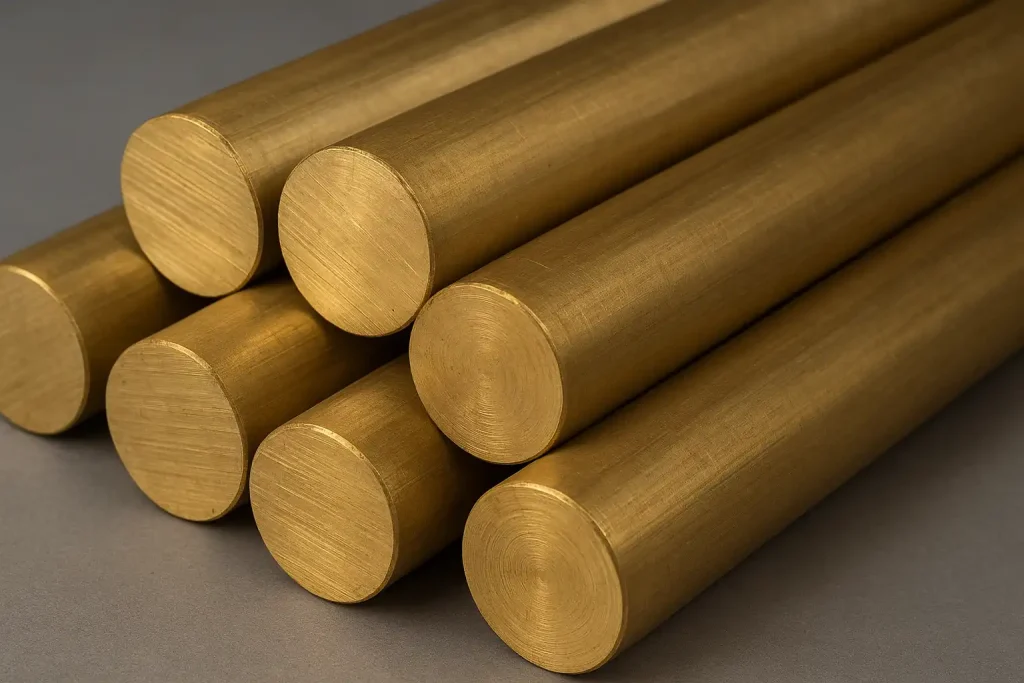
Helps resist temperature rise under high friction or cavitation service. - Color Appearance: Deep golden to reddish-gold
Often used to visually differentiate marine-grade components from standard bronze or brass.
Typical Mechanical Properties of Cast Aluminum Bronze
Values represent common ranges for cast aluminum bronzes under standard casting or heat-treated conditions.
- Tensile strength: 70–105 ksi (480–720 MPa)
Strength increases as the microstructure becomes more complex and as Fe/Ni levels increase. - Elongation: 10–25%
Higher in single-phase α alloys; lower in strengthened or complex-phase grades. - Brinell hardness (HB): 130–240 HB
Dual-phase and complex-phase alloys show significantly higher hardness and wear resistance.
Chemical and Tribological Performance
Aluminum bronze forms a stable, self-repairing aluminum oxide film (Al₂O₃) that controls corrosion and sliding behavior in demanding environments.
- Outstanding resistance to seawater, sulfides, and chemical media
- High resistance to erosion and cavitation in high-velocity or throttling service
- Excellent anti-galling behavior and low adhesive wear for sliding friction components
- Non-magnetic or weakly magnetic, suitable for marine, instrumentation, and aerospace systems
Types of Aluminum Bronze Alloys
Different alloying elements are added to the copper-aluminum base to achieve specific mechanical properties.
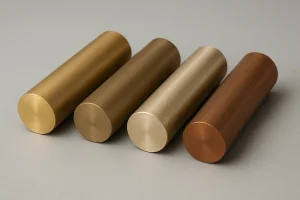
We categorize our casting capabilities into four main families based on chemical composition:
1. Standard Aluminum Bronze (Cu-Al-Fe)
This is the most widely used category, characterized by the addition of Iron. The iron content refines the grain structure, significantly increasing tensile strength and wear resistance compared to plain copper-aluminum alloys.
- Key Features: High mechanical strength, excellent wear resistance.
- Typical Grades: C95200, C95400.
- Applications: Heavy-duty gears, wear plates, and bushings.
2. Nickel Aluminum Bronze (Cu-Al-Ni-Fe)
Commonly referred to as NAB, this alloy includes Nickel and Iron to create a complex microstructure. It offers superior performance in corrosive environments and is denser and stronger than standard grades.
- Key Features: Exceptional resistance to seawater corrosion, cavitation, and erosion.
- Typical Grades: C95500, C95800.
- Applications: Ship propellers, seawater pumps, valve bodies, and desalination components.
3. Silicon Aluminum Bronze (Cu-Al-Si)
In this specialized alloy, Silicon replaces some of the aluminum content. It is designed to offer better machinability while maintaining good strength and corrosion resistance. It also exhibits extremely low magnetic permeability.
- Key Features: Enhanced machinability, low surface friction, and non-magnetic properties.
- Typical Grades: C95600.
- Applications: Valve stems, landing gear components, and hardware requiring low magnetic signatures.
4. Manganese Aluminum Bronze (Cu-Al-Mn)
This category contains a significant amount of Manganese, which acts as a strengthener and deoxidizer. It is specifically engineered to withstand high-velocity water flow and vibration.
- Key Features: High damping capacity and excellent resistance to impingement attack.
- Typical Grades: C95700.
- Applications: High-velocity ship propellers and impellers.
Typical Cast Aluminum Bronze Grades
The following cast grades are based on ASTM B148 and listed using the CA#/Ingot#/tensile strength format used in engineering procurement.
- C95200: Standard α aluminum bronze with moderate strength and good corrosion resistance for general valve and pump components.
- C95300: Dual-phase aluminum bronze offering better wear resistance for bushings, gears, and guiding elements.
- C95400: Strengthened aluminum bronze with high hardness for heavy-load sliding and impact-prone wear surfaces.
- C95500: Nickel aluminum bronze with outstanding cavitation and erosion resistance for continuous-duty fluid systems.
- C95800: Marine-grade nickel aluminum bronze providing stable long-term performance in seawater and high-velocity fluids.
Engineering note: In marine applications, erosion resistance, cavitation control, and antifouling stability often outweigh tensile strength alone.
How Aluminum Bronze Compares with Other Copper Alloys
Vs. Tin Bronze and Brass
When evaluating aluminum bronze, engineers often compare it with conventional tin bronze and brass. The choice is rarely based on strength alone; it depends on how the material endures sliding wear, vibration, seawater contact, and long-term operating loads.
Tin bronze machines well and performs reliably in moderate bearing or lubricated environments, but it is less resistant to erosion and sulfide-rich seawater. Aluminum bronze offers distinctly higher tensile and fatigue strength under rotating or sliding loads, making it more suitable for heavy-duty bushings and components exposed to high-velocity fluids.
Brass is cost-effective and easy to machine, but its susceptibility to dezincification and its limited wear resistance restrict its use in propulsion systems, thrust components, and offshore valves. Aluminum bronze withstands chemical attack, scaling, and abrasive wear far better, particularly in marine environments.
Vs. Manganese Bronze and Silicon Bronze
Compared with engineering bronzes such as manganese bronze and silicon bronze, aluminum bronze maintains a more balanced combination of strength, sliding resistance, and corrosion stability. While manganese and silicon bronzes may reach good strength levels, they do not provide the same durability against cavitation, erosion, and biofouling in seawater.
Nickel- or iron-strengthened aluminum bronzes deliver long-term microstructural stability under cyclic loads and continuous exposure to aggressive fluids. This makes them better suited to propulsion, seawater pumping, desalination, and high-velocity components where both load and corrosion resistance are critical.
In essence, aluminum bronze is not a premium version of other copper alloys; it is the preferred material when a component must maintain structural integrity and corrosion resistance under motion, fluid flow, and long-duration service.
Advantages of Aluminum Bronze
- Highly resistant to seawater and chemical media
- High strength and superior fatigue resistance for continuous duty
- Excellent sliding friction behavior; non-galling properties
- Strong erosion and cavitation resistance for high-velocity fluids
- Mostly non-magnetic, suitable for sensitive equipment
- Long service life reduces maintenance and downtime
Limitations of Aluminum Bronze
- Aluminum readily oxidizes → requires controlled melting and pouring
- Higher shrinkage → more stringent riser and feeding system design
- Localized hardness → increases cutting tool wear during machining
- Higher material cost → but economically favorable over full life cycle
Typical Applications of Aluminum Bronze
- Marine and Offshore Equipment: propellers, hubs, seawater valves, deep-sea pump housings
- Heavy-Duty Wear Components: gears, bushings, wear guides, liners
- Fluid and Pump Systems: valves, sealing components, throttling parts
- Aerospace and Instrumentation: non-magnetic actuators, sliding mechanisms
Conclusion
Aluminum bronze is not a general-purpose bronze alloy. It offers a balanced combination of corrosion resistance, load-bearing capability, sliding wear stability, erosion resistance, and long-term durability.
Proper selection of aluminum bronze must consider working medium, wear mechanism, load conditions, and expected service life in order to fully leverage its engineering benefits.
Looking for the right aluminum bronze alloy for your component?
We can review your drawings and help identify which grade and structure best fits your load, wear, and corrosion requirements.
👉 Upload your component design or material requirement for a technical review.